If you’re new to web design, you probably want to know which web design software is worth the investment. You might also want to know what the must-haves are that every web designer should know.
Choosing a great web design tool comes down to its functionality and purpose. There isn’t one best all-in-one solution. Depending on your goal, you may need to use more than one design tool to achieve the best-designed website.
We recommend testing out several types of web design software to learn which one suits your work the most.
To help you find what you’re looking for, we’ve put together a list of the 12 best web design software tools for building websites, graphic design, interface design, and prototyping.
How to Choose the Right Web Design Software
Before diving into the list, it helps to understand what kind of tool you actually need. Web design software falls into a few broad categories, and picking the right one depends on your goals and skill level:
- Website builders (like WordPress, Wix, and Webflow) let you create and publish complete websites. They’re ideal if you want to get a site online without writing code from scratch.
- UI/UX design tools (like Figma and Sketch) are focused on creating mockups and prototypes. They’re best for planning how a website looks and feels before it’s built.
- Graphic design tools (like Photoshop, Canva, and Pixelmator) help you create images, logos, and visual assets for your site.
- Code-based tools (like Bootstrap and Dreamweaver) give developers more control over how a site is built, but require some coding knowledge.
If you’re a complete beginner looking to launch a website, start with a website builder. If you’re a designer creating layouts for clients, a UI/UX tool is the better choice. And if you need to create graphics or edit photos for an existing site, a graphic design tool will serve you best.
Many professionals use a combination – for example, designing in Figma, building in WordPress, and creating graphics in Canva.
1. WordPress – For Beginners
Here at WebsiteSetup, we recommend people use WordPress to create their own website.
Why?
Through our experience creating hundreds of sites, we’ve found that WordPress offers the best combination of flexibility, power, and ease-of-use necessary to build and launch content-based websites.
And it seems like the internet agrees with us! WordPress now powers over 42.8% of all websites on the internet. This remarkable reach demonstrates WordPress’s continued dominance in the web development space.
WordPress powers popular blogs, e-commerce stores, communities, and more. To get started with WordPress, you have two options: set up a self-hosted WordPress site or just sign up for a free WordPress.com account.
If you’re just looking to host a small personal site, WordPress.com may be a great choice. However, if you’re starting a more complex project, a self-hosted WordPress site is probably a better option.
With modern WordPress, the block editor (Gutenberg) and Full Site Editing make it easier than ever to customize your site’s layout and design without touching code. If you’re looking for even more design flexibility, popular page builders like Elementor remain excellent options.
2. Wix – For Drag-and-Drop Website Building
Wix is one of the most popular website builders available, and for good reason. If you want to create a professional-looking website without any coding knowledge, Wix’s drag-and-drop editor makes the process remarkably straightforward.
Wix offers over 2,000 designer-made templates covering virtually every type of website – from business sites and portfolios to online stores and blogs. Each template is fully customizable, so you can adjust layouts, fonts, colors, and images to match your brand.
What makes Wix stand out is its balance of simplicity and power. The editor works more like a native design app than a typical website builder, giving you precise control over where elements appear on the page. Wix also includes built-in features for SEO, marketing, ecommerce, and even AI-powered design assistance to help you get started faster.
The free plan includes Wix branding and a Wix subdomain, which is fine for testing. For a professional site, you’ll want a paid plan that removes ads and lets you connect a custom domain. Paid plans start at $17/month (billed annually), with ecommerce unlocked from $29/month.
If WordPress feels like more than you need, or you’d rather not deal with hosting and plugins, Wix is an excellent alternative for getting a polished site online quickly.
3. Bootstrap – For Web Developers
Originally created by the engineering team at Twitter, Bootstrap remains the world’s most popular framework for building responsive, mobile-first websites.
Put simply, Bootstrap is a free library of HTML, CSS, and JavaScript that simplifies the process of coding a website from scratch. Bootstrap offers dozens of features like a grid system, responsive breakpoints, and a large library of components that make coding a website quick and easy.
The component library includes headers, navigation, buttons, forms, alerts, and more. The Bootstrap team has comprehensively documented each feature, complete with examples and suggestions for customization.
To get started with Bootstrap, simply download the latest version of the Bootstrap framework (currently Bootstrap 5.3, with v5.3.8 being the most recent release), copy one of the example templates, and start coding.
4. Dreamweaver – For Web Designers
Dreamweaver is Adobe’s application for coding, editing, and maintaining websites. It lets you edit websites both by coding them manually and through an intuitive visual interface.
Dreamweaver includes many of the features of a traditional, text-based Integrated Development Environment (IDE) like syntax-highlighting, automatic code completion, and the ability to collapse and expand sections of code. You can even use Dreamweaver with Bootstrap!
Unlike a traditional IDE, however, Dreamweaver’s visual interface is what makes it really stand out. Any changes you make in your website’s code are automatically displayed in real-time in Dreamweaver’s interface, and you can also point and click to edit your website’s code visually.
It’s worth noting that Dreamweaver hasn’t received a major feature update since 2022. While it remains a capable tool, Adobe’s development focus has shifted to other products. If you’d like more power than a simple drag-and-drop editor, but need something simpler than a code-only IDE, Dreamweaver is still a solid option – just be aware that it may not receive significant new features going forward.
Dreamweaver is available as a standalone app for $22.99/month (billed annually), or as part of Adobe Creative Cloud Pro – which bundles 20+ Adobe apps – for $54.99/month. Pricing is correct as of early 2026; check adobe.com for the latest rates.
5. Figma (Freemium)
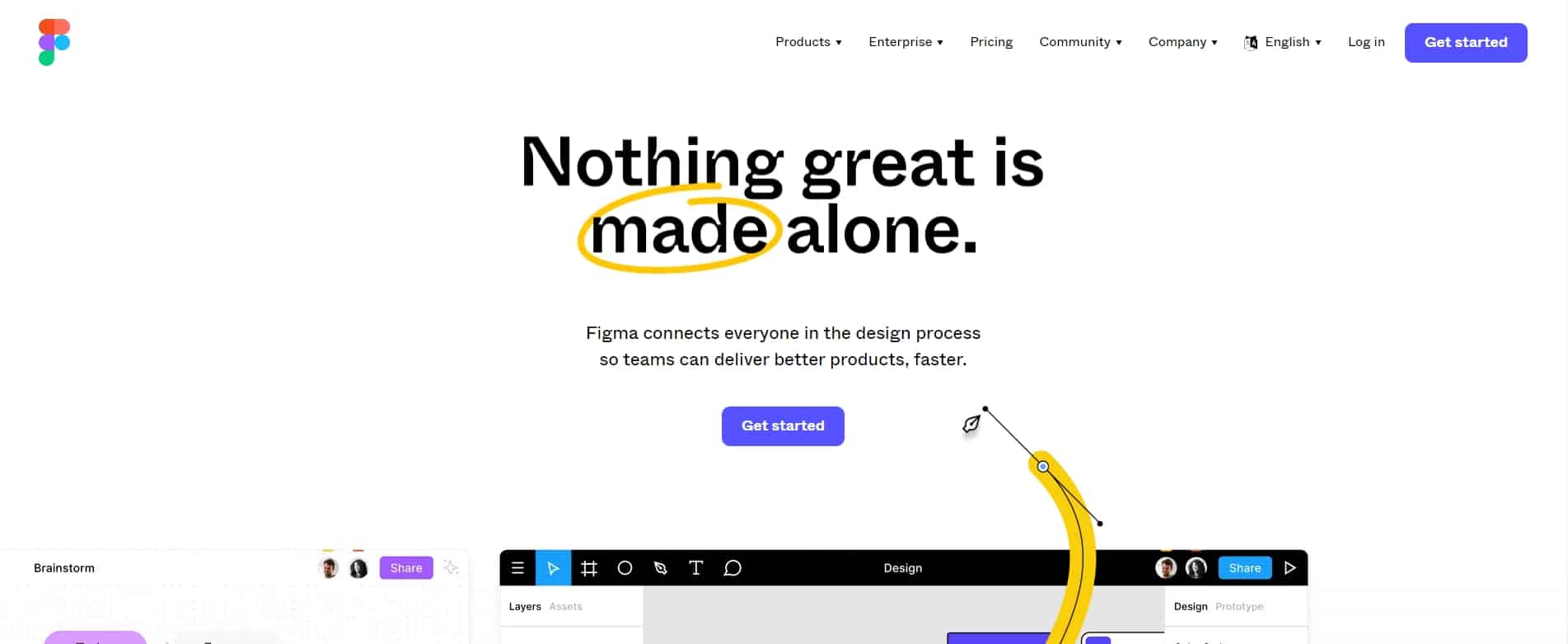
Figma has established itself as the leading design platform for interface design and prototyping. Whether you’re designing a website, mobile app, or any digital product, Figma is the tool most design teams reach for in 2026.
Figma features an intuitive, vector-based interface that makes designing websites simple. It handles everything from wireframing and high-fidelity mockups to interactive prototyping and developer handoff.
What makes Figma really shine is its collaborative, cloud-based approach. Multiple team members can edit a design file simultaneously. Business stakeholders can leave comments, and developers can inspect designs and copy code snippets to simplify the process of turning your design into a real site. Figma also includes FigJam (a collaborative whiteboard) and Figma Slides for presentations, making it a comprehensive design platform.
Figma offers a free Starter plan with up to 3 design files and 3 FigJam boards. Paid plans run from $12/month per editor (Professional, billed annually) up to $90/month per editor (Enterprise). Pricing correct as of early 2026; check figma.com/pricing for current rates.
6. Sketch (Free Trial)
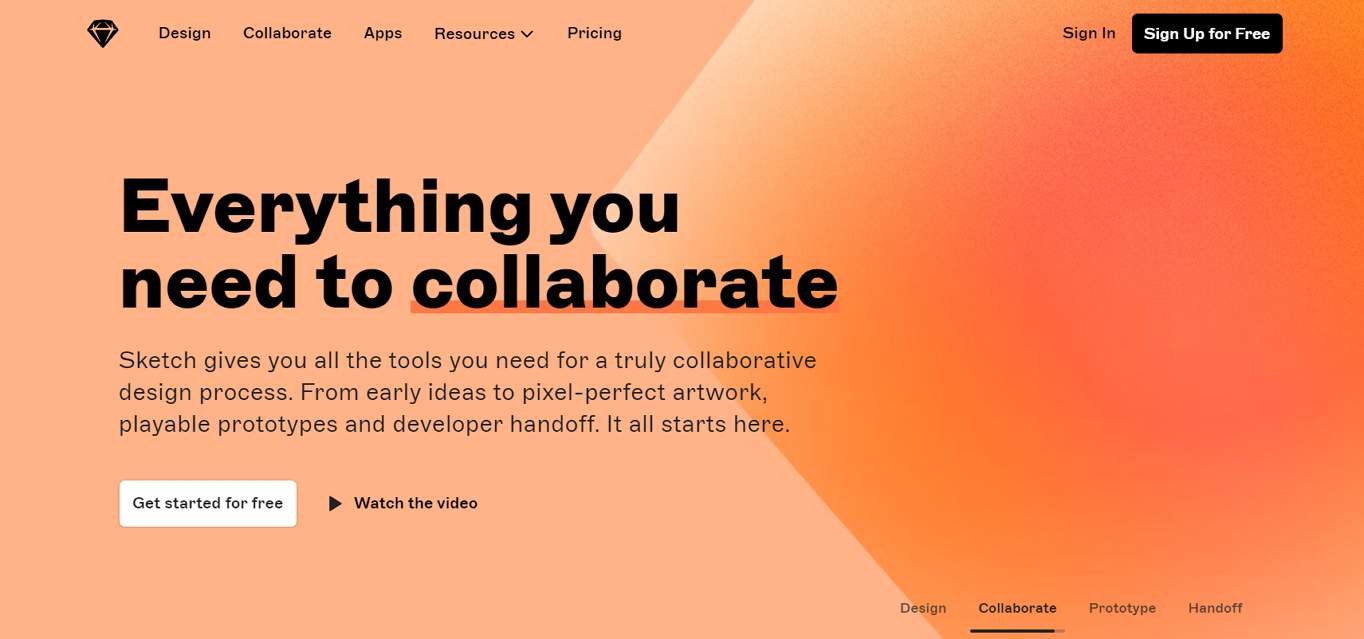
Sketch is an extremely popular interface design tool focused on simplifying the process of creating beautiful, high-fidelity mockups. Sketch gained popularity in the early 2010s when it won a design award from Apple.
Designers love Sketch because its uncluttered and intuitive interface makes it easy to create beautiful designs quickly, without the steep learning curve often associated with other design tools. Sketch also has a comprehensive ecosystem of plugins and integrations that bring added power and make it simple to integrate Sketch into your workflow.
While Sketch has added features for prototyping and collaboration over the years, the program isn’t as advanced in these areas as Figma. Sketch remains a strong choice for macOS-only design teams who prefer a focused, streamlined tool.
Sketch is available on a 30-day free trial, after which plans start at $12/month per editor (Standard, billed annually) or $24/month per editor (Business). Solo designers who don’t need collaboration tools can opt for the Mac-only license at $120 – a one-time purchase that includes one year of updates and is yours to keep forever. Pricing correct as of early 2026; check sketch.com/pricing for current rates.
7. Webflow – For No-Code Web Design
Webflow bridges the gap between visual website builders and hand-coded sites. If you want the design freedom of writing CSS and HTML but prefer a visual interface, Webflow is an excellent choice.
Webflow’s editor lets you build responsive websites by dragging and dropping elements onto a canvas, while it generates clean, production-ready code behind the scenes. Unlike simpler drag-and-drop builders, Webflow gives you granular control over layout, spacing, animations, and interactions – essentially putting the power of CSS in a visual interface.
The platform also includes a built-in CMS for managing blog posts, portfolio items, or any dynamic content, plus ecommerce capabilities for online stores. Webflow hosts the sites you build, so there’s no need to set up separate hosting.
Webflow is particularly popular with designers and agencies who want pixel-perfect results without relying on developers to code their designs. The learning curve is steeper than Wix, but the design flexibility is significantly greater.
Webflow offers a free Starter plan for building and prototyping on a webflow.io subdomain (limited to 2 pages and 50 CMS items). Paid site plans start at $14/month (Basic, billed annually – custom domain, no CMS), rising to $23/month for the CMS plan (ideal for blogs and content-driven sites) and $49/month for Business (higher traffic and expanded CMS needs). Enterprise pricing is available on request. Pricing correct as of early 2026; check webflow.com/pricing for current rates.
8. Framer – For Designers Who Want to Ship Websites
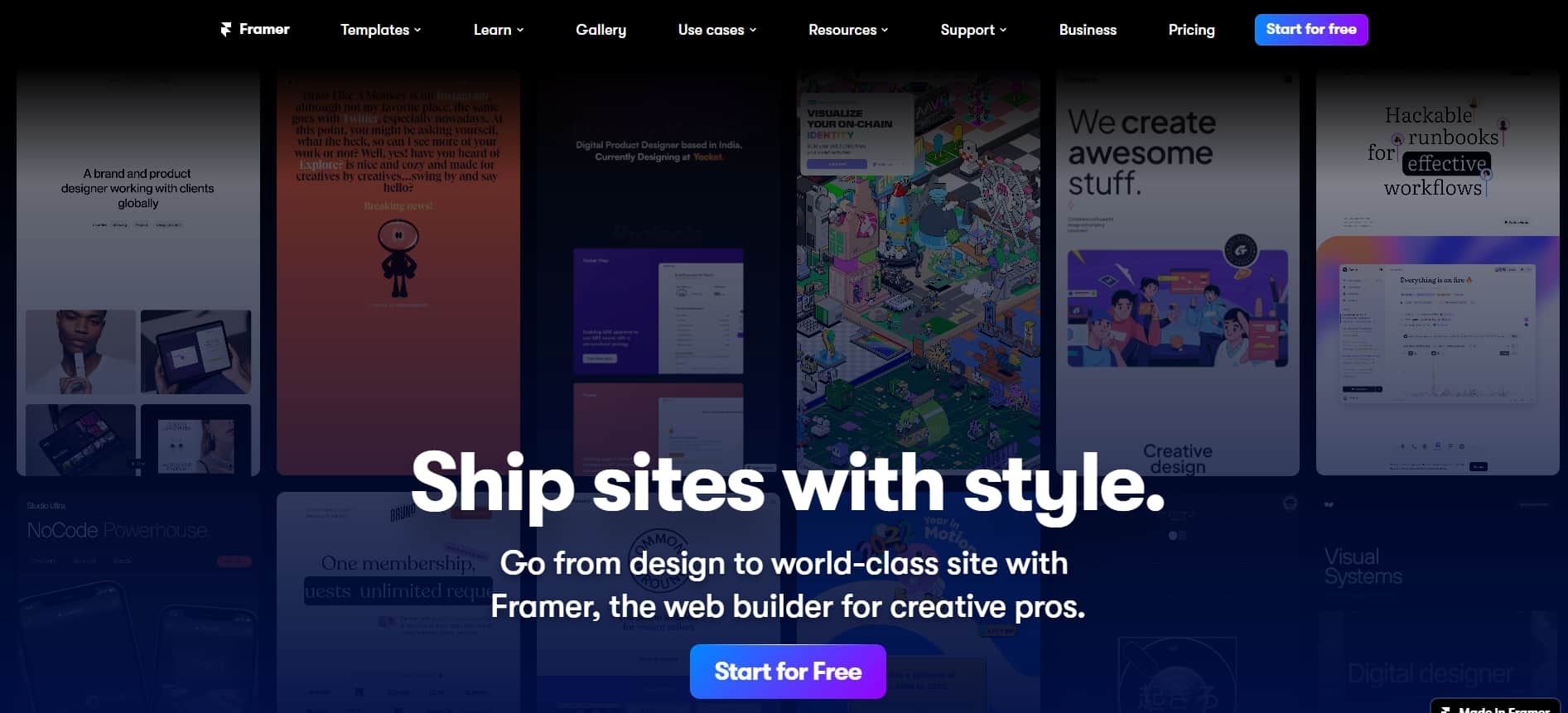
Framer has evolved significantly from its origins as a prototyping tool. In 2026, Framer is a full-featured no-code website builder with a design interface that feels similar to Figma.
What sets Framer apart is how seamlessly it combines design and publishing. You design your pages on a freeform canvas, add animations and interactions, and publish directly – no handoff to a developer needed. Framer generates fast, optimized websites with clean code.
Designers like Framer for its responsive design features, built-in CMS, an array of premade components, and support for advanced animations. The platform also supports real-time collaboration, so teams can work on a site together. AI-powered features can help generate layouts and localize content into multiple languages.
If you’re a designer who wants to go from concept to live website in a single tool, or if you’re building marketing sites and landing pages that need to look polished, Framer is a fantastic option.
Framer offers a free plan for personal and non-commercial use, with paid plans starting at $10/month (Basic, for personal projects and small sites) and $30/month (Pro, for professionals and small teams). A Scale plan at $100/month is available for larger businesses, with Enterprise pricing available on request. Pricing correct as of early 2026; check framer.com/pricing for current rates.
9. Adobe Photoshop (Free Trial)
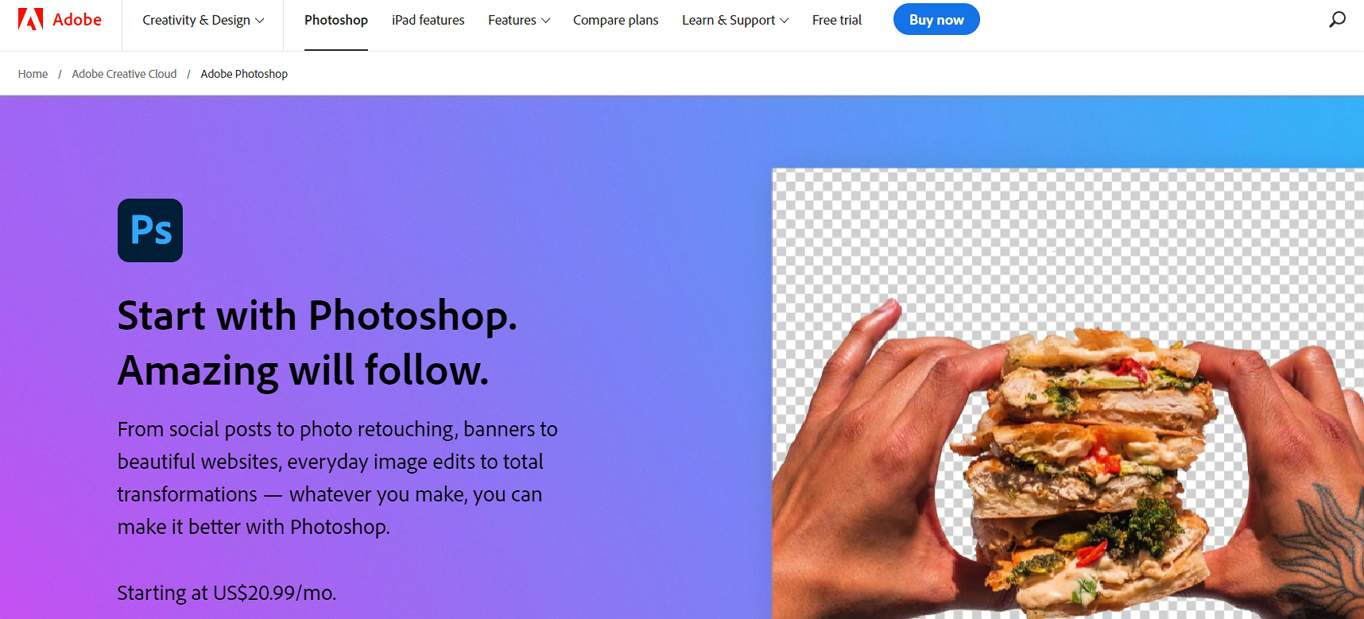
If you’re looking for a powerful, do-it-all graphic design tool, Adobe’s Photoshop has been the leader for decades.
While originally released purely for photo editing, Photoshop has evolved to support a variety of use cases, including interface design, video editing, and more, while remaining true to its photo-editing roots. Adobe has continued to add AI-powered features (through Adobe Firefly) for generative fill, background removal, and other intelligent editing capabilities.
While many designers prefer to work exclusively in Photoshop because of its flexibility, others prefer more specialized tools. Like Adobe’s other products, the learning curve is a bit steeper because of the vast array of tools and options Photoshop offers.
Adobe Photoshop is available as a standalone app for $22.99/month (billed annually), or as part of Adobe Creative Cloud Pro – which includes 20+ Adobe apps – for $54.99/month. Pricing correct as of early 2026; check adobe.com for the latest rates.
10. Canva (Freemium)
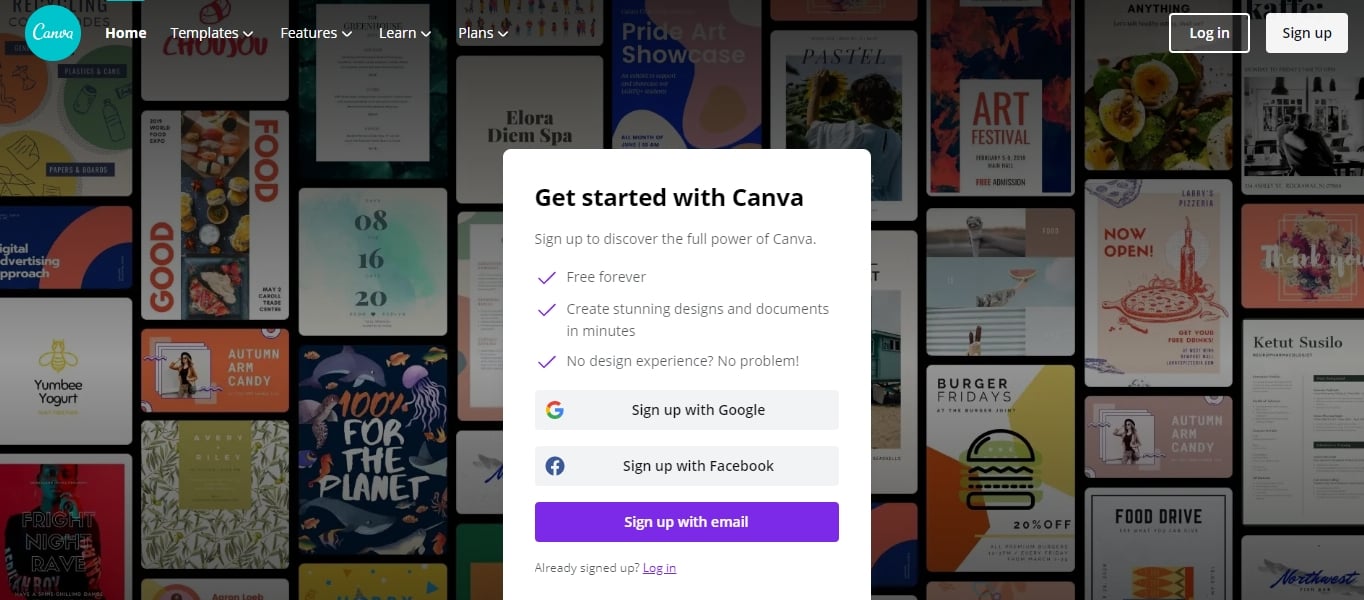
If you need a simple tool for creating graphics for social media posts, flyers, or business cards, Canva is a fantastic option. It’s also expanded into website creation – you can now design and publish simple websites directly from Canva, complete with a free Canva domain.
Users love Canva for its easy-to-use, drag-and-drop interface. With over 3.6 million templates and hundreds of design types, marketers and hobbyists can produce beautiful imagery in just a few clicks. Canva now serves over 265 million monthly active users worldwide.
For web design specifically, Canva works best for creating mockups, marketing graphics, and simple single-page sites. If you need a full-featured website with multiple pages and dynamic content, a dedicated website builder like WordPress or Wix is a better fit. But for visual assets and quick sites, Canva is hard to beat.
Canva offers a generous free plan alongside Canva Pro at $15/month (or $120/year) for individuals who need premium templates, AI tools, and expanded storage. Teams and businesses can upgrade to Canva Business at $20/person/month, which adds collaboration tools, brand management, and higher AI usage limits – with no seat minimum. Enterprise pricing is available on request. Pricing correct as of early 2026; check canva.com/pricing for current rates.
11. Vectr (Free)
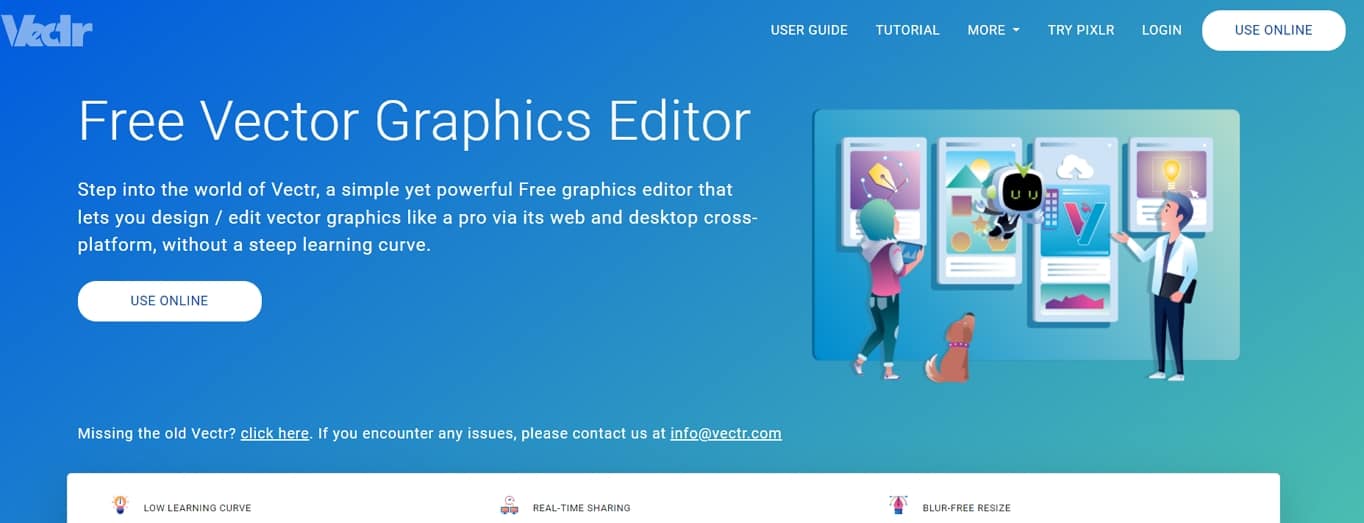
Vectr is a free, cloud-based illustration tool with features similar to Sketch and Adobe Illustrator.
If you want to create complex illustrations, or simply design a website or mobile app, Vectr offers everything you need to get started.
Vectr’s drag-and-drop editor is easy to learn, and since it’s cloud-based, it’s easy to share designs with others for feedback and collaboration. Vectr remains free for core vector editing, making it an accessible choice for beginners and budget-conscious designers – though premium tiers are now available for users who want additional AI-powered features like image-to-vector conversion and logo generation.
12. Pixelmator (Freemium)
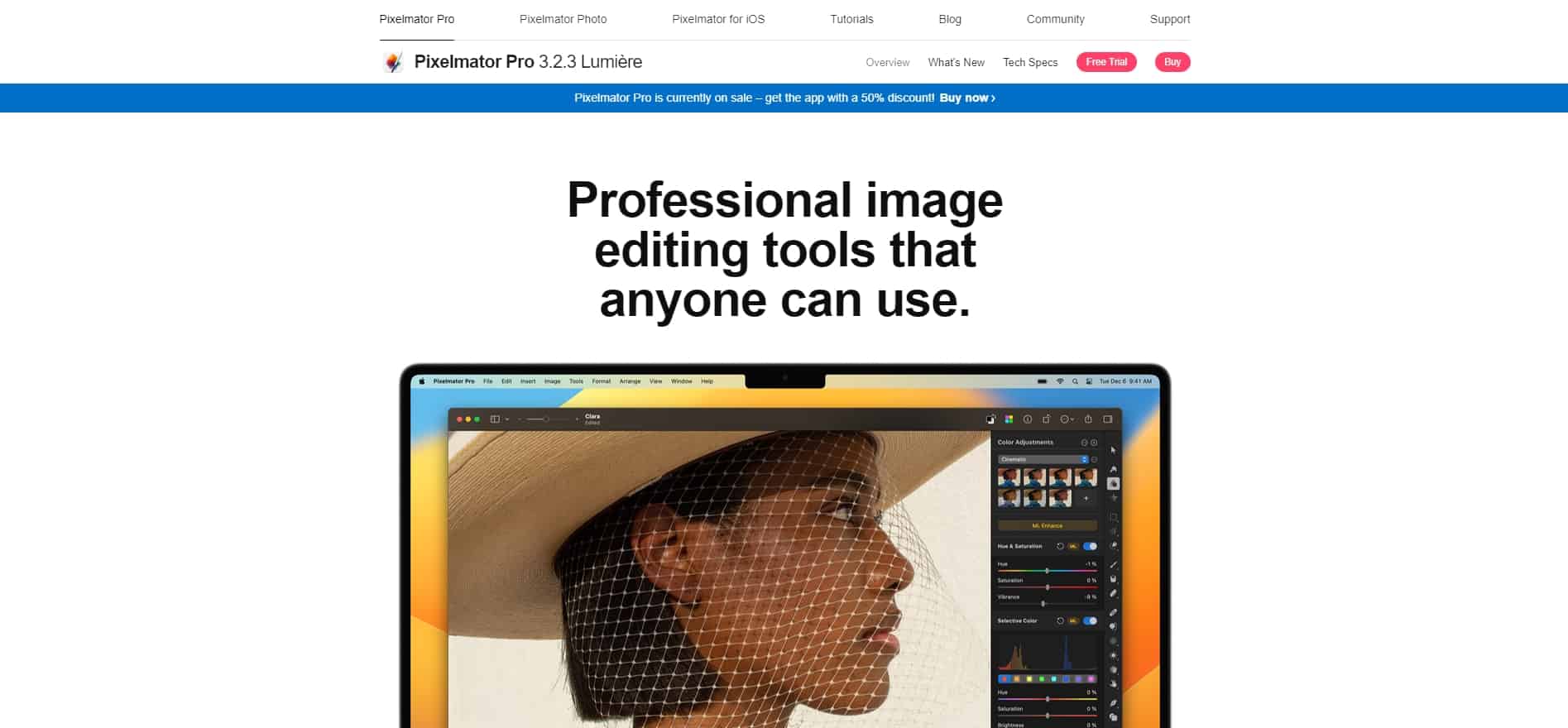
Much like Photoshop, Pixelmator Pro is a feature-rich photo editor for macOS.
While you can use Pixelmator for illustration or interface design, it works best as a tool for editing and retouching photos, with features for color correction, retouching, and applying filters. It also includes machine learning-powered features for tasks like automatic background removal and image enhancement.
Pixelmator Pro (acquired by Apple in early 2025) remains available as a one-time purchase for $49.99 on the Mac App Store, and is now also included in Apple Creator Studio – Apple’s new creative app subscription at $12.99/month or $129/year, which bundles Pixelmator Pro with Final Cut Pro, Logic Pro, and more. For iPad users, Pixelmator Pro is only available via the Apple Creator Studio subscription. Pricing correct as of early 2026; check apple.com for current rates.
Pixelmator Pro is available on the macOS App Store. If you’re looking for a powerful photo editor without the ongoing cost of an Adobe subscription, Pixelmator Pro is excellent value.
Frequently Asked Questions
Do I need to know coding to design a website?
No. Many of the tools on this list – including WordPress, Wix, Webflow, Canva, and Framer – let you design and publish websites without writing any code. They use drag-and-drop editors and visual interfaces that are accessible to complete beginners. That said, knowing some HTML and CSS can give you more control over customization if you want it.
What’s the difference between web design software and a website builder?
A website builder (like WordPress, Wix, or Webflow) is an all-in-one platform that lets you design, build, and publish a complete website, often including hosting. Web design software is a broader category that also includes tools focused on specific parts of the process – like Figma for creating mockups, Photoshop for editing graphics, or Bootstrap for coding layouts. You may use one tool or several depending on your project.
What is the easiest web design software for beginners?
For building a complete website, Wix and WordPress.com are the most beginner-friendly options. Wix is especially intuitive with its drag-and-drop editor. For creating graphics and visual assets, Canva is the easiest tool to learn. And for UI/UX design, Figma offers a surprisingly gentle learning curve despite its professional-grade features.
Can I use free web design software for a professional website?
You can get started with free tools, but most have limitations that make them less suitable for professional use. Free plans typically restrict you to a subdomain (like yoursite.wix.com), include platform branding, and limit storage or features. For a professional site, you’ll generally want a paid plan that lets you use a custom domain and removes third-party branding.
Which web design software is best for an online store?
For ecommerce, WordPress with WooCommerce is the most flexible option and what we recommend for most users. Wix also includes solid built-in ecommerce tools. Webflow offers ecommerce features too, though they’re more suited to smaller product catalogs. Dedicated ecommerce platforms like Shopify are also worth considering if selling products is your primary goal.