Email marketing in 2026 looks different from the tool you might have signed up for a few years ago. AI now writes your subject lines, drafts body copy, and predicts the best time to hit send, and most services build this in at no extra cost. The bigger shift is how you pay. Some tools charge by the number of contacts you store, others by the number of emails you actually send, and that one choice can double or halve your bill as your list grows. Email and SMS increasingly live in the same dashboard, so you can reach people who never open their inbox. And the quiet lever behind everything is deliverability: getting your messages into the inbox instead of the spam folder, which now depends heavily on proper authentication (SPF, DKIM, and DMARC). For beginners, the real differentiator is still the free plan. Some are generous. Some are almost useless.
We tested and compared the eight services below with beginners and small businesses in mind, whether you run a new blog, a small store, or a growing newsletter.
How we picked
We signed up for each service, built test campaigns, and worked through the setup steps a first-timer would face. We paid close attention to the free plan, the jump to the first paid tier, and whether the pricing was based on contacts or on emails sent. For deliverability, we leaned on independent 2026 inbox-placement testing from EmailToolTester, which mails identical campaigns through every provider and measures how many land in the inbox versus spam. Prices and numbers below are current as of 2026. Email pricing moves often, intro discounts expire, and rates revert at renewal, so always confirm the current figure on the provider’s own pricing page before you commit.
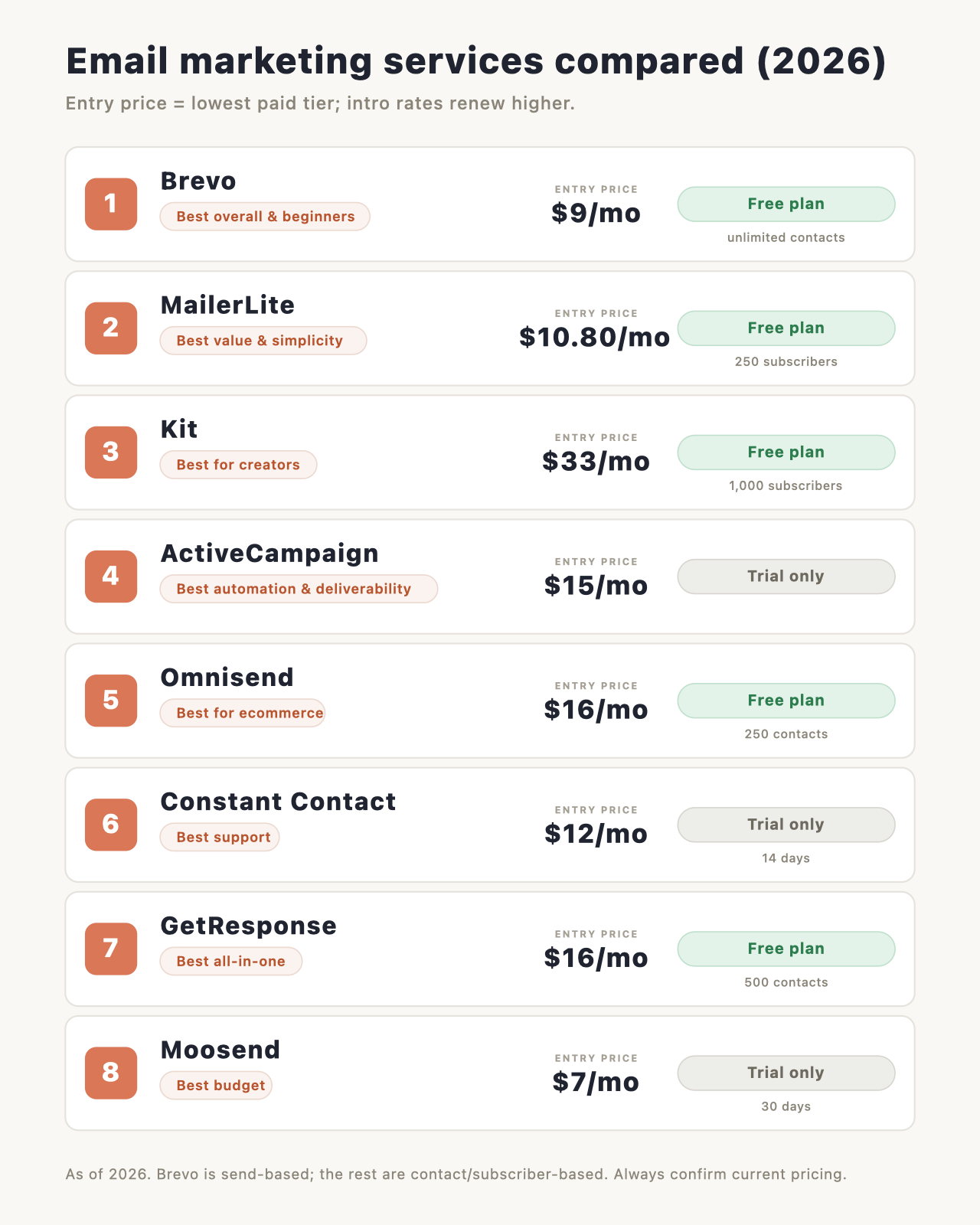
| Service | Best for | Free plan | Entry price/mo (at tier) | Pricing basis | Deliverability |
|---|---|---|---|---|---|
| Brevo | Overall / beginners | Unlimited contacts, 300 emails/day | $9/mo Starter (~5k emails/mo) | Emails sent | 88.3% (mid-pack) |
| MailerLite | Value and simplicity | 250 subscribers, 2,500 emails/mo | $10.80/mo Comfort at 500 subs | Subscribers | 94.41% (best of five rounds) |
| Kit | Creators and bloggers | Up to 1,000 subscribers | $33/mo Creator ($390/yr) at 1k subs | Subscribers | 91.3% |
| ActiveCampaign | Automation and deliverability | None (14-day trial) | $15/mo Starter (annual) at 1k contacts | Contacts | 94.2% (top of class) |
| Omnisend | Ecommerce stores | 250 contacts, 500 emails/mo | $16/mo Standard at 500 contacts | Contacts | 4.5 out of 5 (second) |
| Constant Contact | Support and small business | None (14-day trial) | $12/mo Lite at 500 contacts | Contacts | Full SPF/DKIM/DMARC |
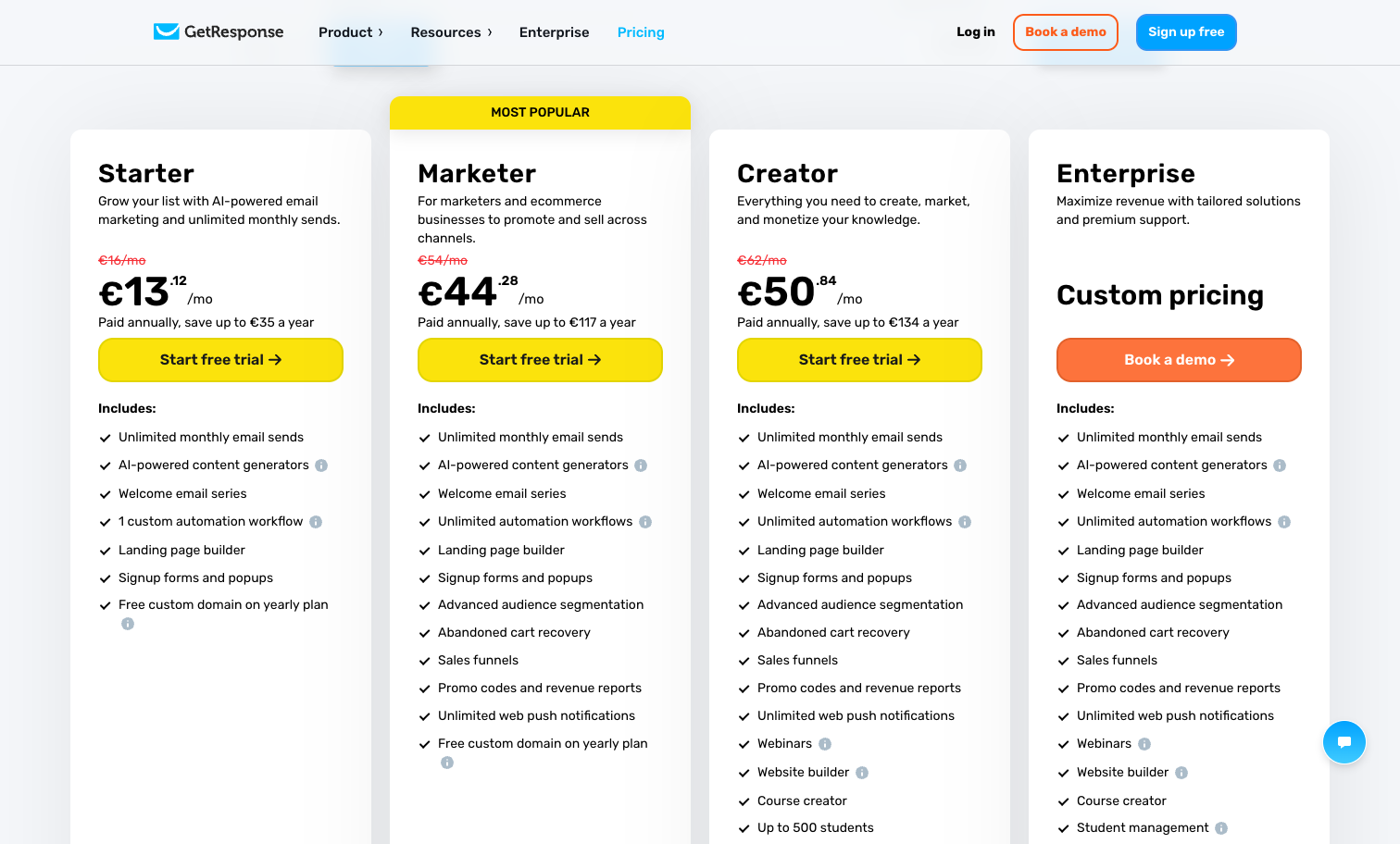
| GetResponse | All-in-one (funnels, webinars) | 500 contacts, unlimited emails | $16/mo Starter at 1k contacts | Contacts | 90.9% (third) |
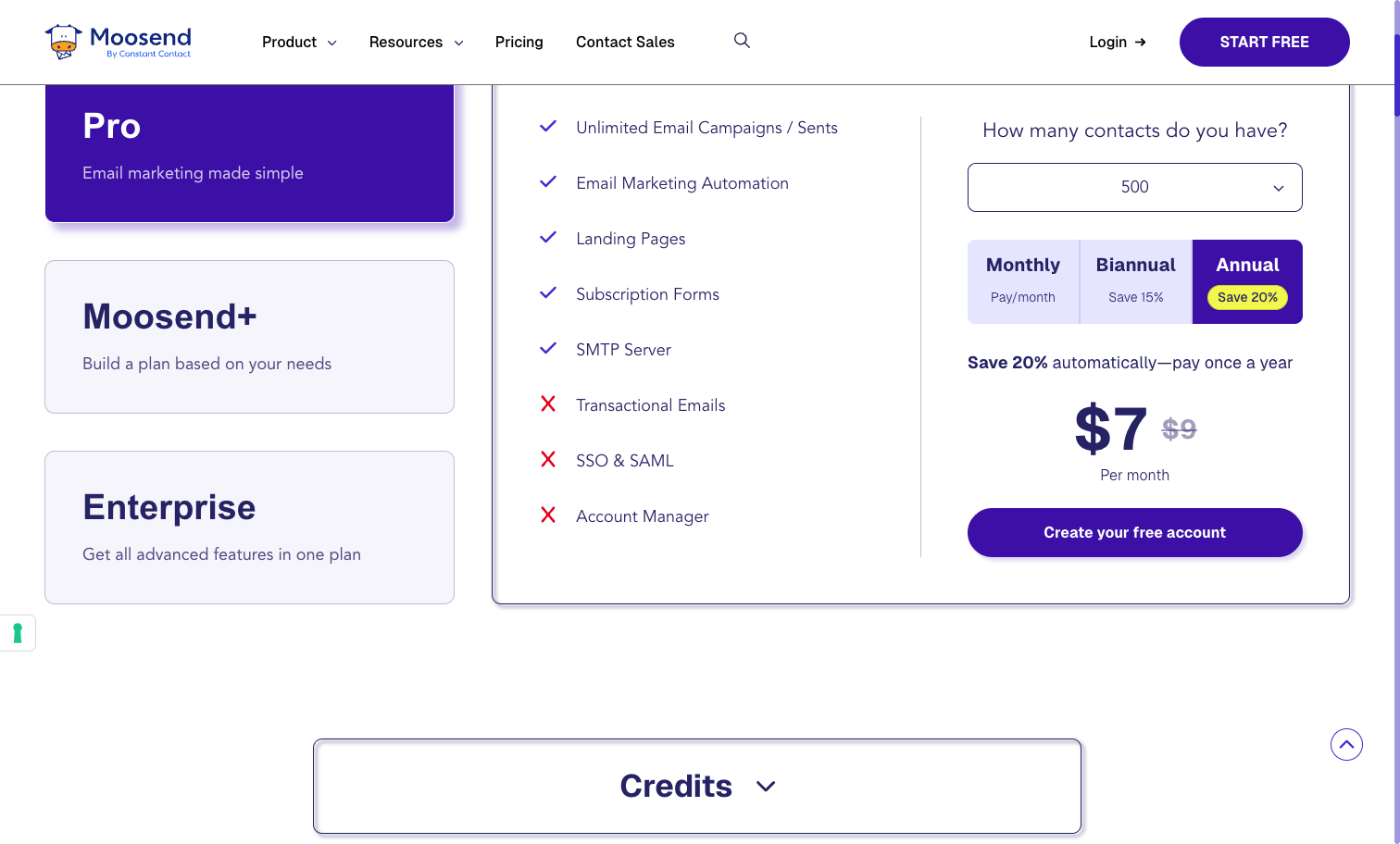
| Moosend | Budget automation | None (30-day trial) | $7/mo Pro (annual) at 500 | Subscribers | Value pick |
The 8 best email marketing services in 2026
1. Brevo: best for beginners and overall value
Brevo, the tool formerly known as Sendinblue, is our top pick for most beginners and small businesses. The reason is simple. It stores unlimited contacts on the free plan, and its paid pricing is based on emails you send rather than contacts you keep. If you have a big list that you email once or twice a month, that model is unusually cheap.
What’s new in 2026: Brevo added its Aura AI assistant and an AI Lab covering predictive lead scoring and content generation. The company also revamped its pricing in late 2025 into Starter, Business, and Enterprise tiers. Email, SMS, WhatsApp, live chat, and a built-in CRM all sit in one account, so you can run more than just newsletters from a single login.
Pros:
- Unlimited contacts on the free plan, which almost no competitor matches
- Send-based pricing that can save frequent list-builders roughly 30 to 40 percent as they scale
- Email, SMS, WhatsApp, and a CRM in one place
- Beginner-friendly editor with AI subject lines and copy built in
Cons:
- The free plan caps you at 300 emails per day, so it suits building a list more than blasting one
- Add-ons like a dedicated IP stack onto the base price
- Deliverability tests it mid-pack rather than at the top
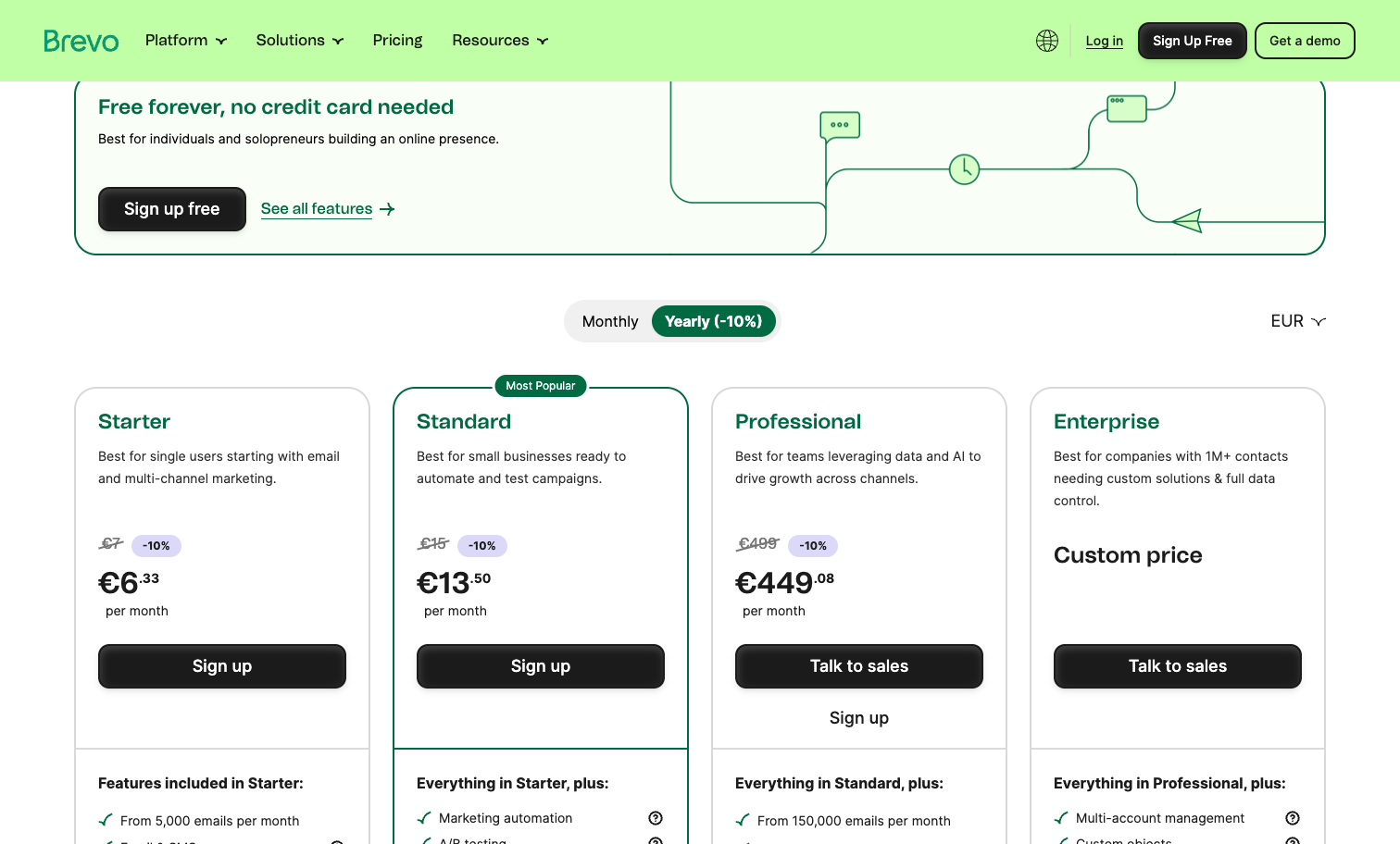
Pricing: The free plan gives you unlimited contacts and 300 emails per day with Brevo branding. The paid Starter plan runs about $9 per month for roughly 5,000 emails a month, and the Business plan is around $18 per month, which adds marketing automation, A/B testing, and removes the daily cap. The basis here is emails sent, not contacts stored, which is rare and works in your favor if you mail infrequently. Prices are current as of 2026 and may change.
Deliverability: In EmailToolTester’s 2026 inbox-placement testing, Brevo landed around 88.3 percent, which puts it in the middle of the pack rather than the top. Solid, not category-leading.
Best for: budget-conscious beginners and small businesses that want email, SMS, and a CRM without paying to store contacts.
2. MailerLite: best for value and simplicity
If Brevo is the value all-rounder, MailerLite is the one we hand to people who just want a clean, easy tool that gets email right. The interface is the most approachable in this roundup, and its deliverability sits at the top end. That combination is hard to beat for a small operation.
What’s new in 2026: MailerLite added an AI writing assistant, dynamic emails that change content per reader, and tools to sell digital products and take bookings directly. The plans were also renamed, so double-check the current tier names when you sign up.
Pros:
- Cleanest, most beginner-friendly interface of any tool here
- Roughly 25 to 40 percent cheaper than comparable tiers elsewhere
- Strong deliverability, one of the best measured
- Can sell digital products and bookings without a separate store
Cons:
- Ecommerce features are thin, with no dynamic discount codes or product revenue tracking
- The free subscriber cap was cut from 1,000 to 250 in late 2025
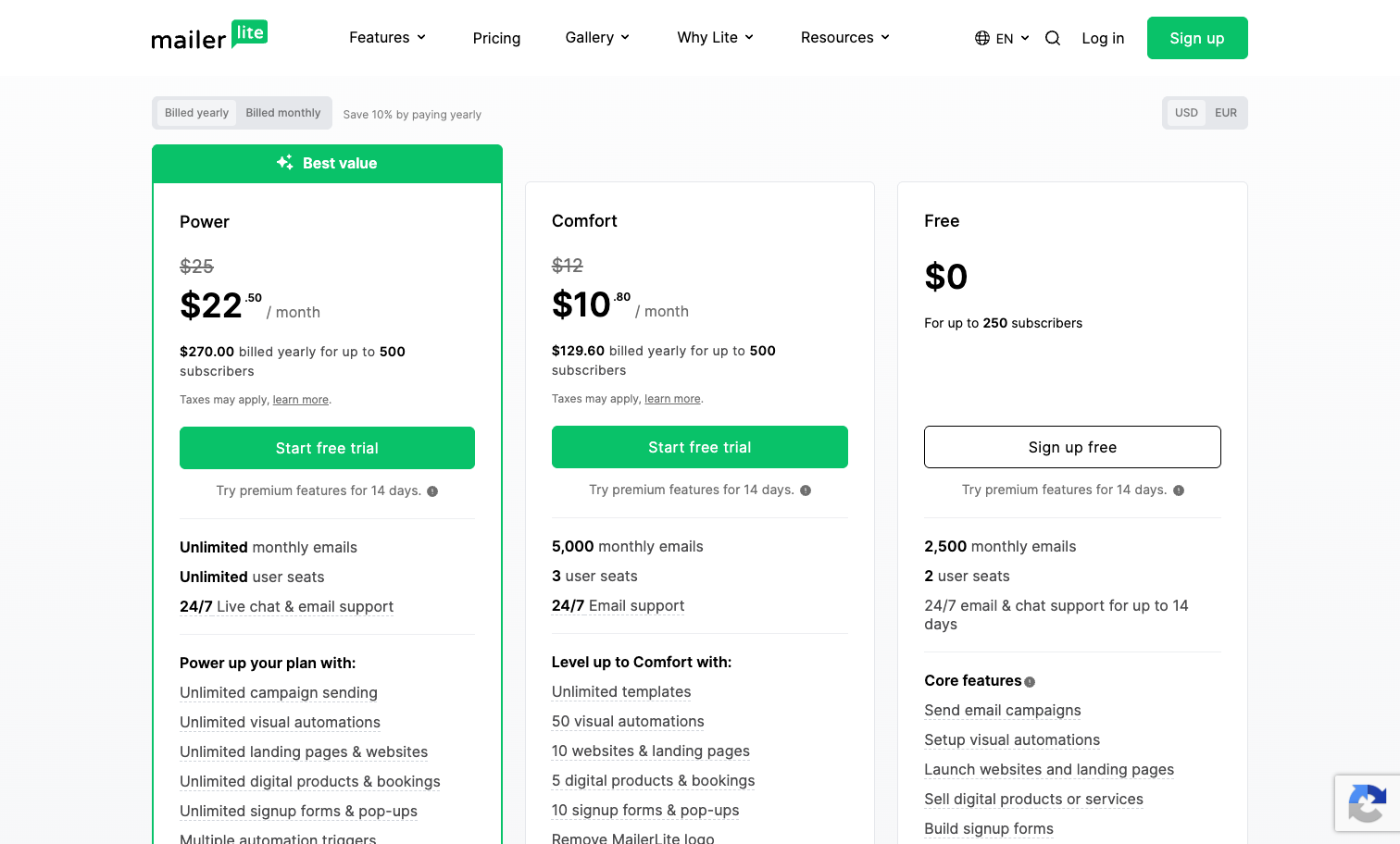
Pricing: The free plan covers 250 subscribers and 2,500 emails per month with MailerLite branding. Paid plans start at about $10.80 per month (the Comfort plan) at 500 subscribers, with the Power plan around $22.50 per month adding unlimited emails. The basis is subscribers, so your bill tracks list size. Prices are as of 2026 and change over time, especially after any intro discount.
Deliverability: MailerLite posted a 94.41 percent average across five rounds of EmailToolTester’s testing, earning a best-of-five result, though a recent single round came in closer to 89.8 percent. Over time it is one of the most reliable performers.
Best for: bloggers, creators, and small businesses that want the simplest strong all-rounder. Building your first site to pair with it? Our step-by-step website guide walks through the basics.
3. Kit: best for creators and bloggers
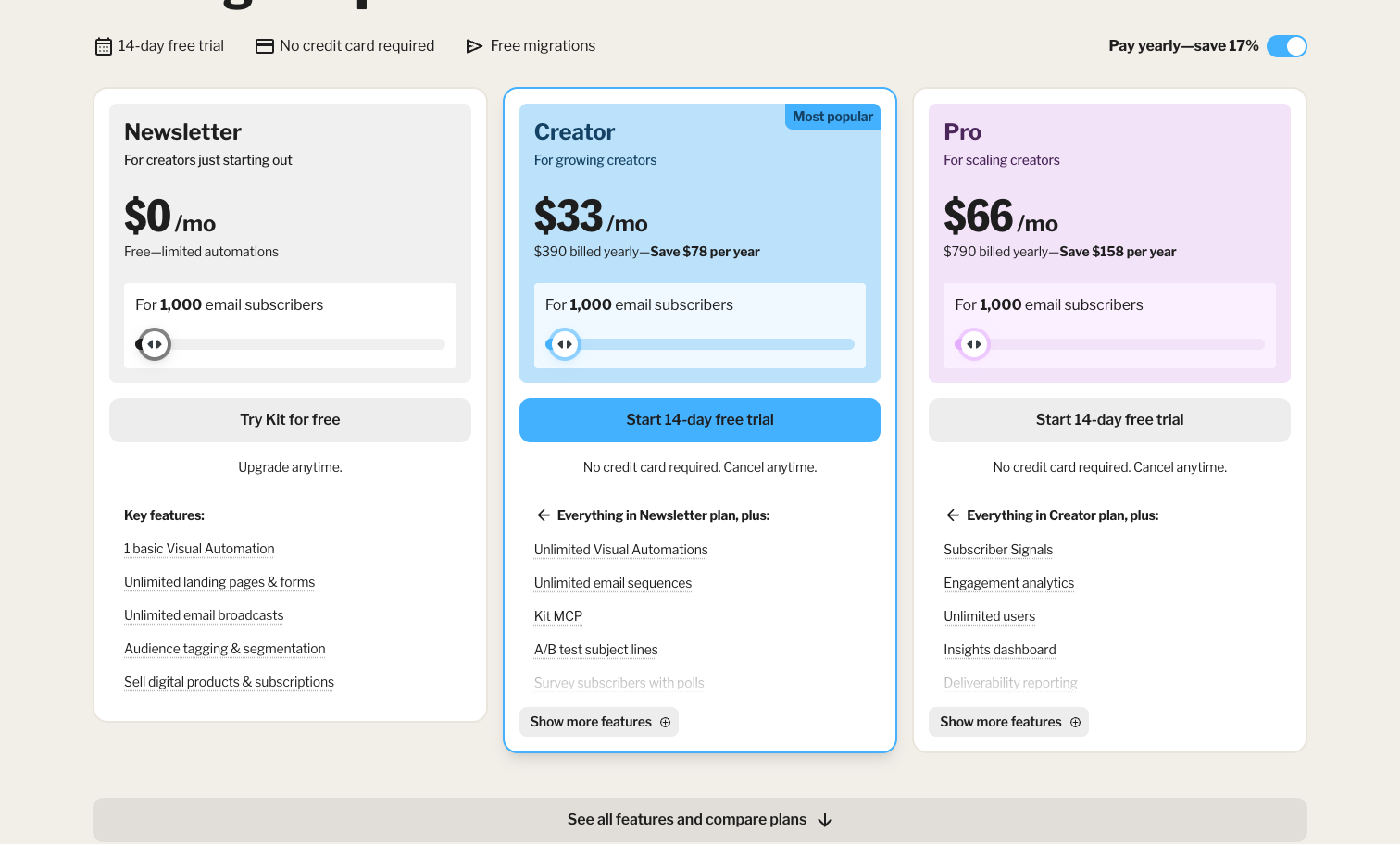
Kit, which was ConvertKit until its October 2024 rebrand, is built around the way creators actually work. It focuses on newsletter growth, monetization, and simple tag-based automation rather than heavy campaign design. If you write, teach, or publish, it fits the mold.
What’s new in 2026: Kit added its Creator Network with paid recommendations, rebuilt its visual automations, and shipped a Kit MCP that lets you draft and send broadcasts from AI assistants like ChatGPT or Claude.
Pros:
- Purpose-built for newsletter growth and creator monetization
- Free tier that covers up to 1,000 subscribers
- Clean, tag-based automation that is easy to reason about
Cons:
- A September 2025 price hike pushed the Creator plan from $15 to $33 per month, a jump of about 120 percent
- Templates and design options are light compared to rivals
- Overkill if you only send an occasional simple newsletter
Pricing: The free plan covers up to 1,000 subscribers with one basic automation and Kit branding. The paid Creator plan is $33 per month, or $390 per year (about $32.50 per month) at 1,000 subscribers, and Creator Pro runs $66 per month. The basis is subscribers, and it gets steep as your list grows. Prices are as of 2026 and subject to change.
Deliverability: Kit measured around 91.3 percent in EmailToolTester’s 2026 testing, a solid four-star result that sits comfortably above average.
Best for: professional creators, newsletter publishers, and course sellers who want tools shaped around their business. A newsletter is one of the more reliable ways to earn from a website.
4. ActiveCampaign: best for automation and deliverability
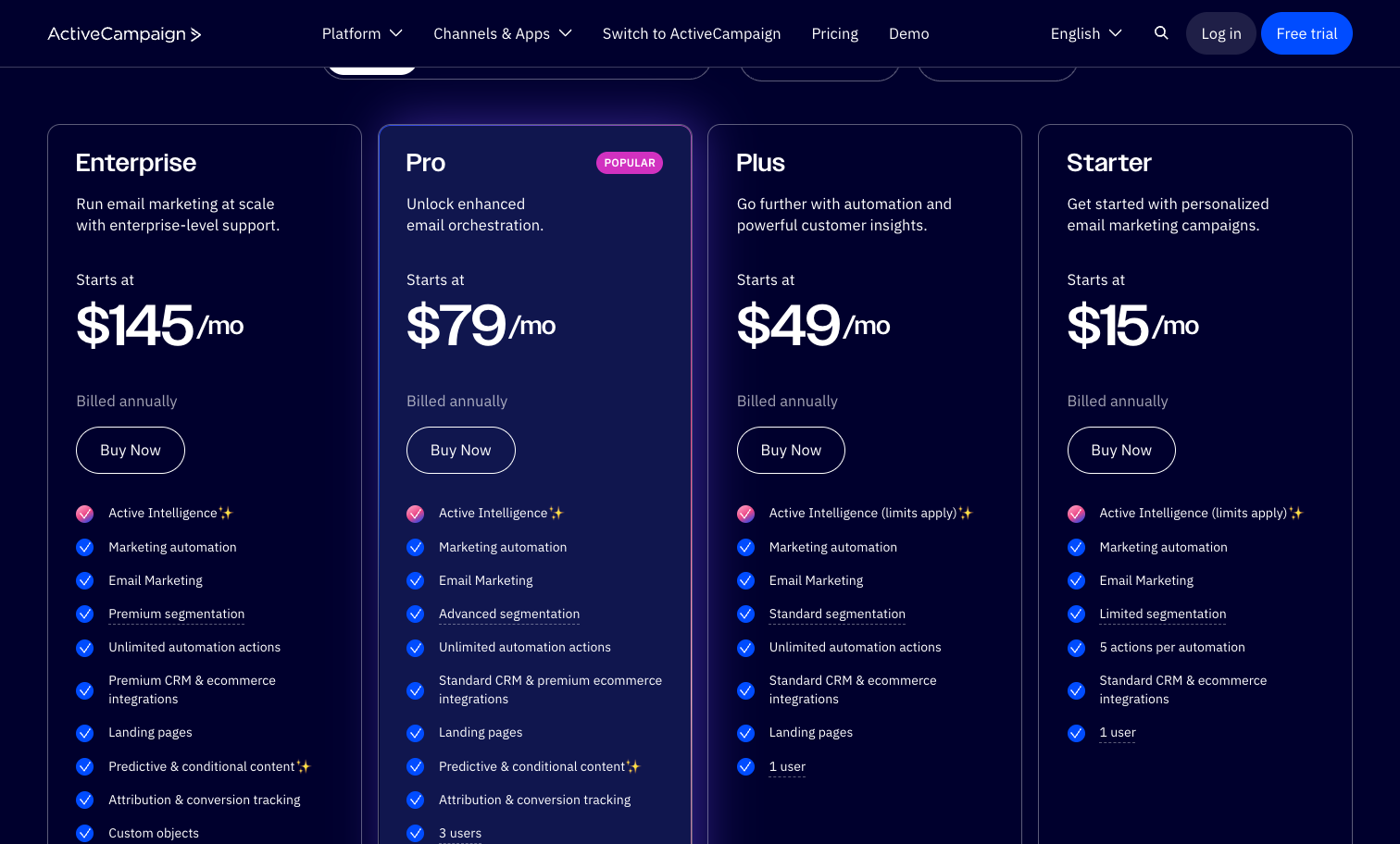
ActiveCampaign is the power tool of this list. Its automation builder is the deepest here, and its inbox placement is the best measured. That power comes with a learning curve and a bill that climbs quickly, so it rewards people who will actually use the depth.
What’s new in 2026: The platform added Active Intelligence with autonomous AI agents, predictive sending that picks the optimal send moment per contact, more than 40 new integrations including Wix and Webflow, and WhatsApp automation.
Pros:
- The most capable automation and workflow builder in this roundup
- Top-ranked deliverability, reclaiming the number one spot in testing
- Predictive send-time and a large integration library
Cons:
- As of November 2025, new customers are billed for their entire list, including unsubscribed and bounced contacts
- Prices have roughly doubled over three years
- A real learning curve, and the built-in CRM is basic
Pricing: There is no free plan, only a 14-day trial with no card required. The Starter plan begins at $15 per month billed annually at around 1,000 contacts, and roughly 20 percent more month to month. Costs scale steeply from there, reaching well over $1,400 per month at 50,000 contacts on higher tiers. The basis is contacts, and remember that new accounts are billed on the full list. Prices are as of 2026 and change often.
Deliverability: ActiveCampaign hit about 94.2 percent in EmailToolTester’s 2026 testing, retaking the top position among the major tools.
Best for: power users and B2B teams that need advanced automation and best-in-class inbox placement.
5. Omnisend: best for ecommerce stores
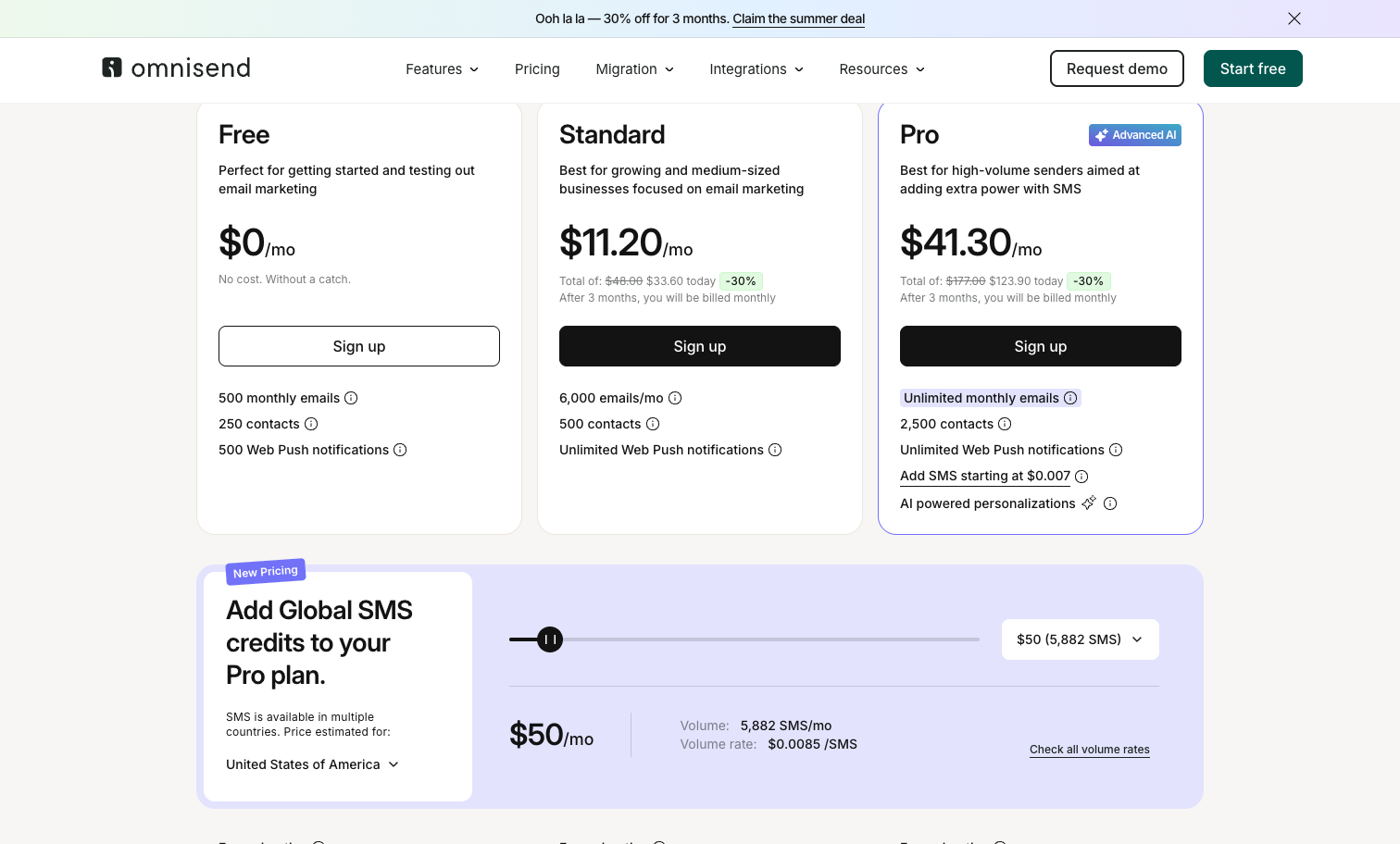
Omnisend is built for online stores. It bundles email, SMS, and web push into one package, connects deeply to Shopify, WooCommerce, and BigCommerce, and ships the abandoned-cart and revenue-tracking features a store needs on day one.
What’s new in 2026: Omnisend introduced an AI Segment Builder and gamified signup forms, and it overhauled SMS pricing in May 2026, which stripped included credits from the new Pro plan.
Pros:
- Email, SMS, and unlimited web push in one ecommerce-focused tool
- Deep integration with Shopify, WooCommerce, and BigCommerce
- 24/7 live chat support on every plan, including the free one
Cons:
- Billable contacts include non-subscribers such as cart abandoners
- Templates are retail-focused and less useful outside a store
- SMS gets expensive at higher volume
Pricing: The free plan covers 250 contacts, 500 emails per month, and 500 web-push messages with branding. The Standard plan is $16 per month, often around $11.20 with an intro discount, at 500 contacts, and Pro is $59 per month, roughly $41.30 introductory, at 2,500 contacts. The basis is contacts, and those counts include non-subscribers, so watch your list. Prices are as of 2026 and revert after intro periods.
Deliverability: Omnisend earned 4.5 out of 5 in EmailToolTester’s 2026 testing, second only to Klaviyo among ecommerce tools.
Best for: Shopify and WooCommerce stores that want email, SMS, and push in one place. If you are still setting up shop, see our guide on starting an online store.
6. Constant Contact: best for support and hands-on small businesses
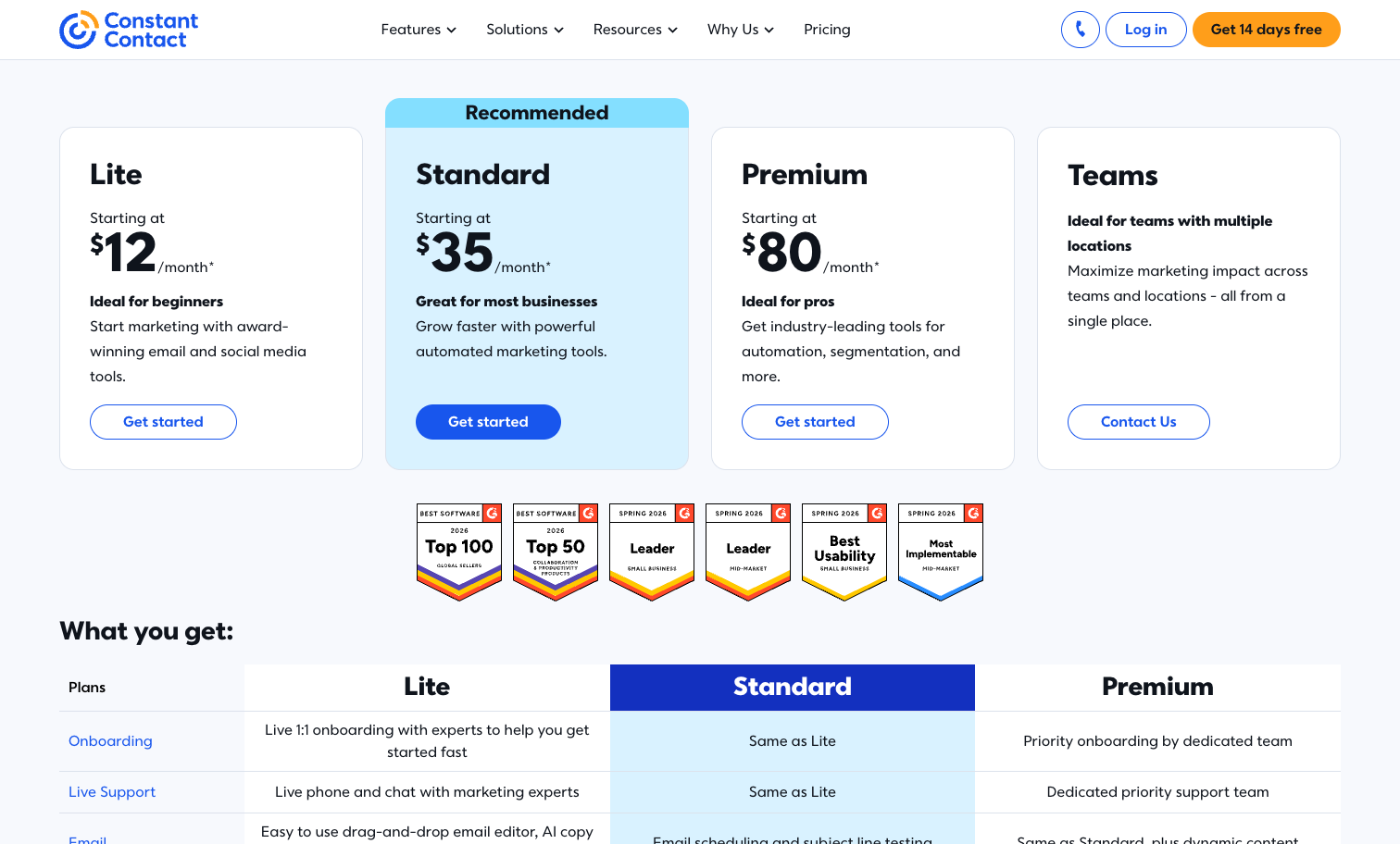
Constant Contact is the pick for people who want a human to talk to. Its onboarding and editor are friendly for non-technical users, and it offers phone and chat support that most rivals reserve for higher tiers or skip entirely. You pay for that comfort with a higher price and lighter automation.
What’s new in 2026: The company added an AI Content Generator that drafts email, social, SMS, and landing page copy, and it repriced its Lite, Standard, and Premium plans in 2025.
Pros:
- Beginner-friendly onboarding and editor
- More than 300 integrations plus strong event and social tools
- Phone and chat support that beginners actually reach
Cons:
- Expensive relative to the feature set
- Limited automation and segmentation compared to rivals
- No free plan, and templates feel dated
Pricing: There is no free plan, only a 14-day free trial. The Lite plan starts at $12 per month at 500 contacts, with up to 15 percent off on annual billing, and Standard and Premium sit above it. The basis is contacts, and pricing climbs steeply as your list grows. Prices are as of 2026 and change periodically.
Deliverability: Constant Contact supports full SPF, DKIM, and DMARC authentication, though it does not expose a deliverability dashboard, so you get the tools without the detailed reporting some rivals provide. EmailToolTester’s testing places it among the reliable mainstream options.
Best for: non-technical small businesses and nonprofits that value support above all.
7. GetResponse: best all-in-one with funnels and webinars
GetResponse tries to be the whole marketing stack. Beyond email, it includes sales funnels, landing pages, and built-in webinars, which is rare. If you want to run a launch from signup form to checkout inside one tool, it covers the whole path.
What’s new in 2026: GetResponse added AI generators for email, subject lines, and landing pages, plus an AI campaign builder that assembles a campaign from a single goal prompt. Its old Autofunnel became the Conversion Funnel, and it launched a Creator plan for courses and newsletters.
Pros:
- End-to-end sales funnels from landing page to email to webinar to checkout
- Built-in webinars, which almost no competitor includes
- Unlimited emails from a low starting price
Cons:
- Ecommerce value weakens on the higher tiers
- Advanced features are gated behind pricier plans
Pricing: The free plan covers 500 to 1,000 contacts, unlimited monthly emails, and one landing page, but no automation. The Starter plan runs about $16 per month, roughly $13 billed annually, at 1,000 contacts, and the Marketer plan is around $54 per month. The basis is contacts. Prices are as of 2026 and shift with promotions and renewals.
Deliverability: GetResponse reached about 90.9 percent in EmailToolTester’s 2026 testing, a solid third-place showing among the tools we tracked.
Best for: marketers who want funnels and webinars bundled with their email. Pairing campaigns with content is one of the better ways to grow your website traffic over time.
8. Moosend: best budget pick for automation
Moosend, owned by Sitecore, is the value play. It offers automation that feels closer to the enterprise tools than its price suggests, which makes it a smart choice when the budget is tight but you still want real workflows.
What’s new in 2026: Moosend continues to lean on affordable automation as its main draw, with a template-based workflow builder and AI-assisted content tools that keep it competitive with pricier rivals.
Pros:
- Enterprise-style automation at an entry-level price
- Straightforward editor that beginners can pick up quickly
- Strong value for the feature set
Cons:
- No permanent free plan, only a trial
- Smaller ecosystem and fewer integrations than the big names
Pricing: Moosend offers a 30-day free trial rather than a free plan. Its Pro plan starts at $7 per month billed annually, about $9 month to month, at 500 contacts, with the basis being contacts. Prices are as of 2026 and change over time.
Deliverability: Moosend was not covered in the same EmailToolTester round as the others, so treat its inbox placement as untested here rather than assume top-tier performance. It remains a value pick on price and features first.
Best for: budget-minded users who want serious automation without a serious bill.
Also worth knowing
A few well-known names did not make our ranked list, but you should know where they stand.
- Mailchimp: still the most recognized name, and still capable, but we demoted it. Intuit has raised prices repeatedly, and in mid-2025 the free tier was gutted to 250 contacts and 500 emails with automations moved behind paid plans. Contact-based scaling gets expensive fast, and it posted the weakest deliverability of the major tools in testing. Familiar and feature-rich, but no longer our recommendation for beginners.
- AWeber: known for excellent support, with 24/7 phone help on every tier including free, plus AI writing and its Smart Designer. The interface feels dated, though, and a December 2024 price hike raised rates by 50 to 150 percent. Worth a look if hands-on support is your top priority.
- HubSpot: free for up to 1,000 contacts and tied to a strong CRM. It scales very steeply, adding roughly $45 to $50 per extra 1,000 contacts plus onboarding fees on Pro plans. Best when email is one piece of a larger sales and marketing operation.
- Klaviyo: an ecommerce data powerhouse with five-star deliverability, but it is overkill and pricey for most beginners. If you run a large, data-heavy store, it belongs on your shortlist. If you are just starting, Omnisend covers the same ground more simply.
Email marketing buyer’s guide
How do I choose an email marketing service?
Start with what you sell and how often you email. If you run a store, favor a tool with ecommerce automation like Omnisend. If you publish a newsletter, a creator-focused tool like Kit fits better. Then look at three things in order: the free plan (does it cover your current list size), the pricing basis (contacts or emails sent), and the first paid tier (what it costs when you outgrow free). Deliverability and ease of use are tiebreakers. Do not over-buy. Most beginners need a clean editor, basic automation, and reliable inbox placement, not a 900-step workflow builder.
Free vs paid, is a free plan enough to start?
For most beginners, yes. A free plan is enough to build your first few hundred subscribers, send a regular newsletter, and learn what your audience responds to. Brevo’s unlimited free contacts and Kit’s free tier of up to 1,000 subscribers can cover a small newsletter while you find your feet. You will hit a wall when you need automation, want to remove the provider’s branding, or outgrow the free contact or send limits. That is the moment to upgrade, and by then you will know which paid features you actually use. Free plans exist to get you started, not to run a mature business forever.
Contact-based vs send-based pricing, which is cheaper?
It depends entirely on your habits. Contact-based pricing (MailerLite, Kit, ActiveCampaign, Omnisend, Constant Contact, GetResponse) charges by how many people are on your list, whether or not you email them. Send-based pricing (Brevo) charges by how many emails you actually send. If you have a large list that you email occasionally, send-based is usually much cheaper. If you have a small list that you email daily, contact-based can work out better. One trap to watch: some contact-based tools, including ActiveCampaign for new accounts as of late 2025, bill you for unsubscribed and bounced contacts, so clean your list regularly to avoid paying for dead weight.
What is email deliverability, and how do I improve it?
Deliverability is the share of your emails that reach the inbox instead of the spam folder or oblivion. It matters because roughly 84 percent of marketing email actually reaches the inbox on average, which means about one in six messages never gets seen. The single biggest lever you control is authentication. Set up three DNS records: SPF, which lists the servers allowed to send on your behalf; DKIM, which cryptographically signs your messages so they cannot be tampered with; and DMARC, which tells inbox providers what to do with mail that fails those checks. Most services walk you through adding these records to your domain, and doing so is the closest thing to a deliverability quick win. Beyond authentication, send to people who opted in, keep your list clean, avoid spammy subject lines, and warm up a new sending domain gradually.
How many emails should I send?
Consistency beats volume. For most small businesses and creators, one email a week is a reliable rhythm, and every two weeks is fine when you are starting out. The goal is to show up often enough that people remember you, without emailing so often that they tune out or unsubscribe. Watch two numbers: open rate and unsubscribe rate. If opens hold steady and unsubscribes stay low, your cadence is working. If unsubscribes spike, you are either sending too often or your content is not matching what people signed up for. Quality and relevance carry more weight than hitting a specific number each month.
The bottom line
For most beginners and small businesses, Brevo is the best starting point in 2026, thanks to unlimited free contacts and send-based pricing that stays cheap as your list grows. If you want the simplest possible tool with excellent deliverability, choose MailerLite. If you need deep automation and the best inbox placement, and you will use the power, ActiveCampaign earns its price. And if you run an online store, Omnisend gives you email, SMS, and push in one place built for selling. Whichever you pick, set up SPF, DKIM, and DMARC first, start with the free plan, and upgrade only when a real limit gets in your way.