
Every way you can build a website has been hacked. Not “could be,” has been: WordPress, the big website builders, modern JavaScript frameworks, ecommerce platforms, and the new wave of AI site builders all have documented, large-scale security failures behind them. This page collects the most important website security statistics for 2026, with a source on every figure, organized by how the site was built so you can see where the real risks are.
A note on sources: the numbers below come from security vendors (Patchstack, Wordfence, Sucuri, Sansec, Wiz), independent research (Veracode, Stanford, Symbiotic Security), and primary disclosures (CVE records, vendor advisories, the FTC). Where a widely-repeated stat is poorly sourced or dated, we say so. All figures are as of 2026 and the space moves fast, so treat them as a current snapshot.
Key website security statistics (the short/TL;DR version)
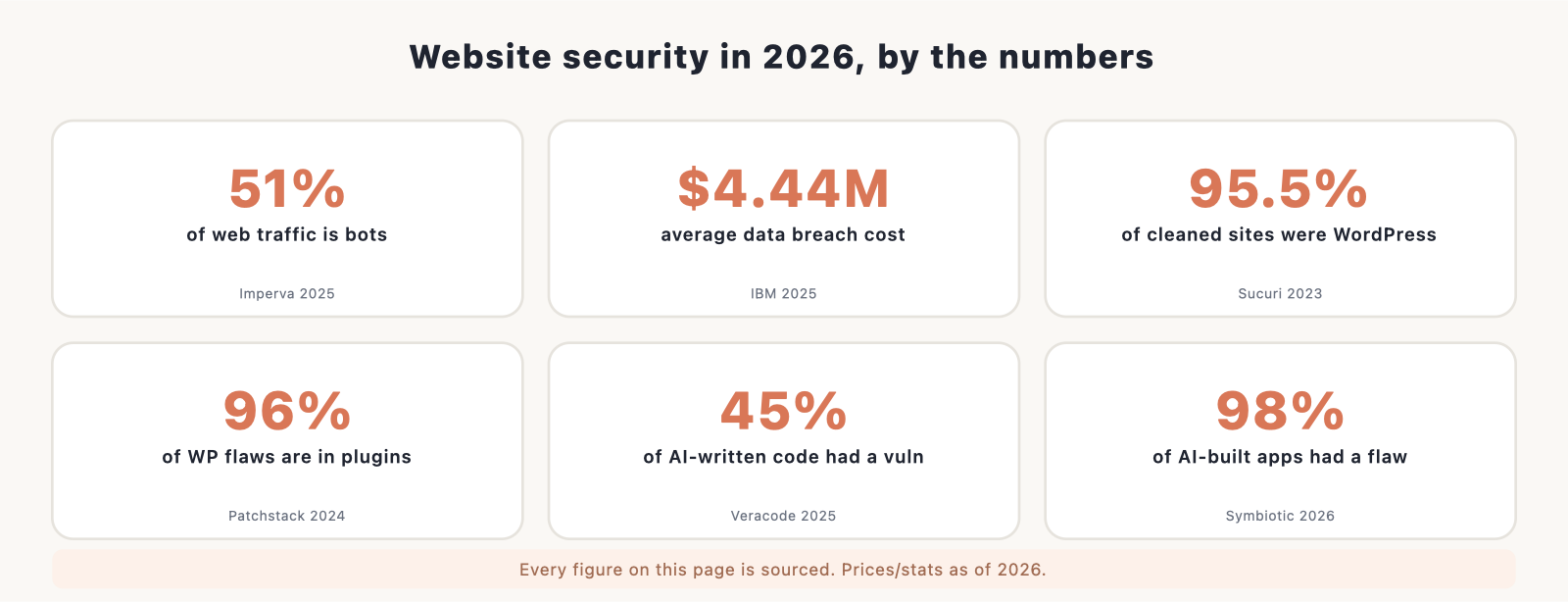
- Automated bots now make up about 51% of all web traffic, and malicious bots about 37%, per Imperva’s 2025 Bad Bot Report.
- The global average cost of a data breach is $4.44 million, and $10.22 million in the US, per the IBM Cost of a Data Breach 2025 report.
- WordPress accounted for 95.5% of the infected websites Sucuri cleaned in 2023, but 96% of WordPress vulnerabilities are in plugins and themes, not the core software (Sucuri, Patchstack).
- 45% of AI-generated code introduced a known security vulnerability in testing, per Veracode’s 2025 GenAI Code Security Report.
- 98% of AI “vibe-coded” apps in one 2026 study had at least one security flaw, per Symbiotic Security.
- Stolen credentials were the single most common way into a breach (22% of cases), per the Verizon 2025 Data Breach Investigations Report.
The rest of this page breaks these down by category and by platform. If you’re still deciding how to build, our guide to how to make a website and our comparison of every way to build a site cover the options; this page covers their security.
General website security statistics
The baseline threat level facing any website, regardless of how it was built:
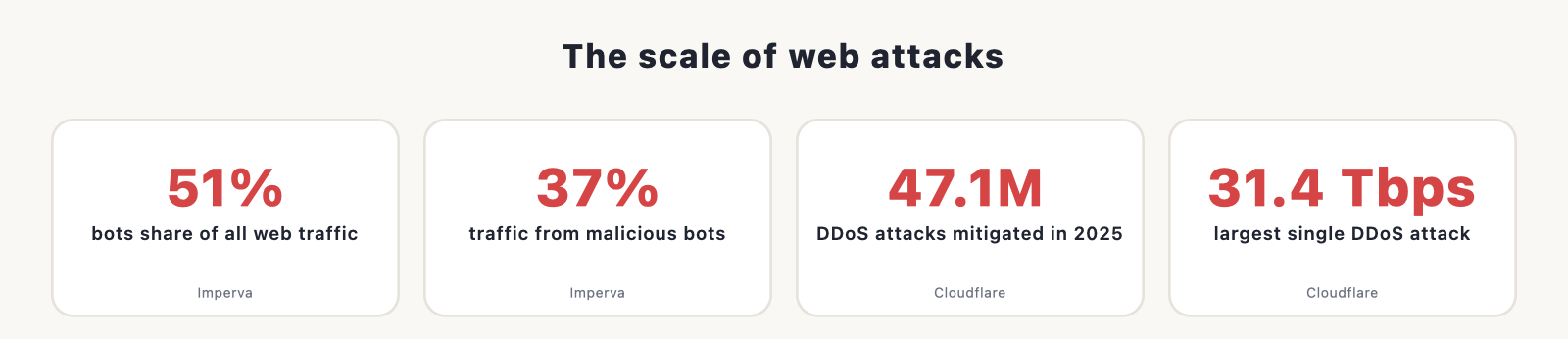
- Automated bots overtook humans as the majority of web traffic in 2025, reaching roughly 51% of all traffic, with bad bots at about 37%, up from 32% the year before (Imperva 2025 Bad Bot Report).
- Cloudflare mitigated 47.1 million DDoS attacks in 2025, up around 121% year over year, and blocked a record single attack that peaked at 31.4 terabits per second (Cloudflare 2025 Q4 DDoS report).
- The often-quoted figure that “30,000 websites are hacked every day” is widely repeated but poorly sourced; it traces back to old secondary articles with no current dataset behind it. Treat it as illustrative, not authoritative.
- Most successful attacks are not sophisticated. The Verizon 2025 DBIR found attackers take the path of least resistance, with stolen passwords and unpatched software doing most of the damage.
The cost of a breach
- The global average cost of a data breach fell to $4.44 million in 2025, the first decline in five years, while the US average climbed to a record $10.22 million (IBM Cost of a Data Breach 2025).
- For small sites the direct cost is rarely millions, but the real damage is cleanup, lost traffic, blocklisting by Google, and lost trust. Prevention is far cheaper than recovery.
How websites get attacked
The categories of attack matter more than any single exploit, and the OWASP Top 10 is the reference list the whole industry uses.
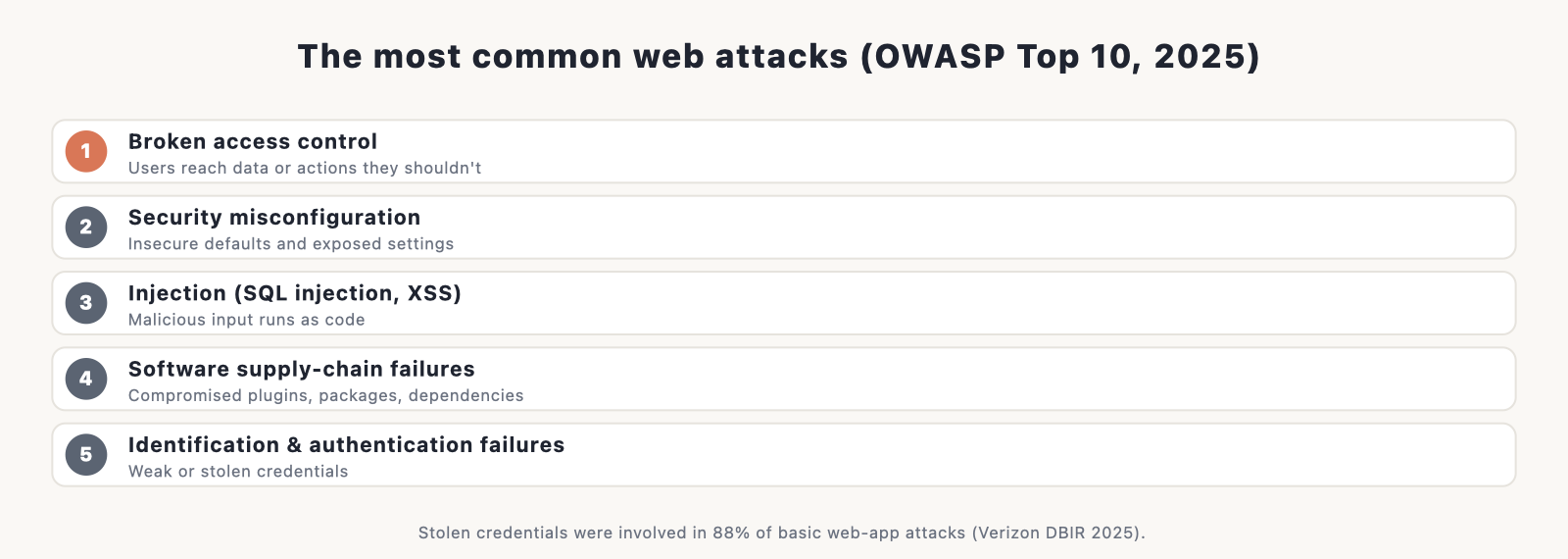
- OWASP released a 2025 update to its Top 10 (the OWASP Top 10 project). Broken Access Control remained the number-one web application risk, Security Misconfiguration rose to second, and a new “Software Supply Chain Failures” category was added, reflecting how attacks have shifted.
- For reference, the still-widely-used 2021 list ranks Broken Access Control first, then Cryptographic Failures, then Injection (which covers SQL injection and XSS) (OWASP Top 10).
- Stolen credentials were the top initial access route in 22% of breaches, and 88% of basic web-application attacks involved stolen credentials (Verizon 2025 DBIR).
- Breaches involving a third party doubled to 30% of all cases, showing how much risk now comes from plugins, packages, and integrations rather than your own code (Verizon 2025 DBIR).
- Injection attacks like SQL injection and cross-site scripting (XSS) remain among the most common web flaws; older Acunetix testing found roughly a third of sites carried an XSS flaw (a dated 2021 figure, but the pattern holds).
- Credential stuffing and brute-force logins are relentless and almost entirely automated, with bots probing login pages around the clock. That is why stolen and weak passwords dominate the breach data above.
- Malware and card skimming inject malicious code to steal data or redirect visitors. On stores this takes the form of Magecart skimmers that lift card details at checkout (Sansec).
- Supply-chain attacks target the code you depend on rather than your site directly, and they have surged: breaches involving a third party doubled to 30% in 2025 (Verizon DBIR).
WordPress security statistics
WordPress powers the largest share of the web, so it takes the most attacks. The crucial nuance: the core software is not the problem, the add-ons are.
- WordPress made up 95.5% of all the infected websites Sucuri cleaned in 2023 (96.2% in 2022) (Sucuri 2023 Hacked Website Report). This largely reflects WordPress’s huge market share, not a uniquely weak core.
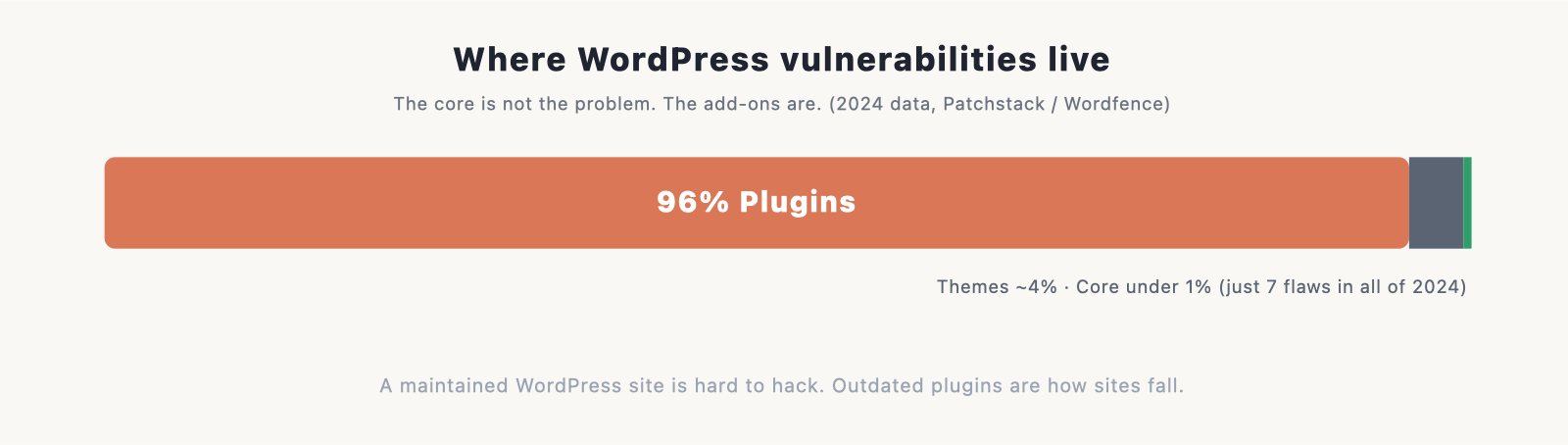
- Of all WordPress vulnerabilities disclosed in 2024, 96% were in plugins, about 4% in themes, and fewer than 1% (just 7) in WordPress core (Patchstack, Wordfence).
- Patchstack catalogued 7,966 new WordPress ecosystem vulnerabilities in 2024, up 34% on the year, and 43% of them were exploitable without any login (Patchstack).
- WordPress attacks are overwhelmingly automated, around 97% of them, and exploit attempts for a newly disclosed flaw often begin within about five hours of publication, faster than most owners patch (Patchstack).
- About a third of the WordPress vulnerabilities disclosed in 2024 had no patch available at the moment they were made public (Patchstack).
- Wordfence reported WordPress vulnerabilities up 68% year over year in 2024, with cross-site scripting the most common type (Wordfence 2024 Annual Report).
- Real-world scale: a 2024 LiteSpeed Cache plugin flaw (CVE-2024-28000) put more than 5 million sites at risk of full takeover (Wordfence), and a second LiteSpeed bug (CVE-2024-44000) exposed around 6 million (BleepingComputer).
- The Balada Injector campaign has infected more than 1 million WordPress sites since 2017 by exploiting plugin and theme flaws, and is still running (The Hacker News, Sucuri).
- Balada works by weaponizing freshly disclosed plugin flaws at scale: it hijacked more than 17,000 sites in a single month in 2023 through one theme-plugin flaw (BleepingComputer), and over 7,100 more through a popup-plugin flaw soon after (The Hacker News).
- The takeaway: WordPress core is well maintained (auto-updates have been on by default since 2013, and only 7 core flaws appeared in all of 2024). Sites get hacked through outdated plugins, nulled themes, and weak passwords, not core.
CMS comparison: WordPress vs Drupal vs Joomla
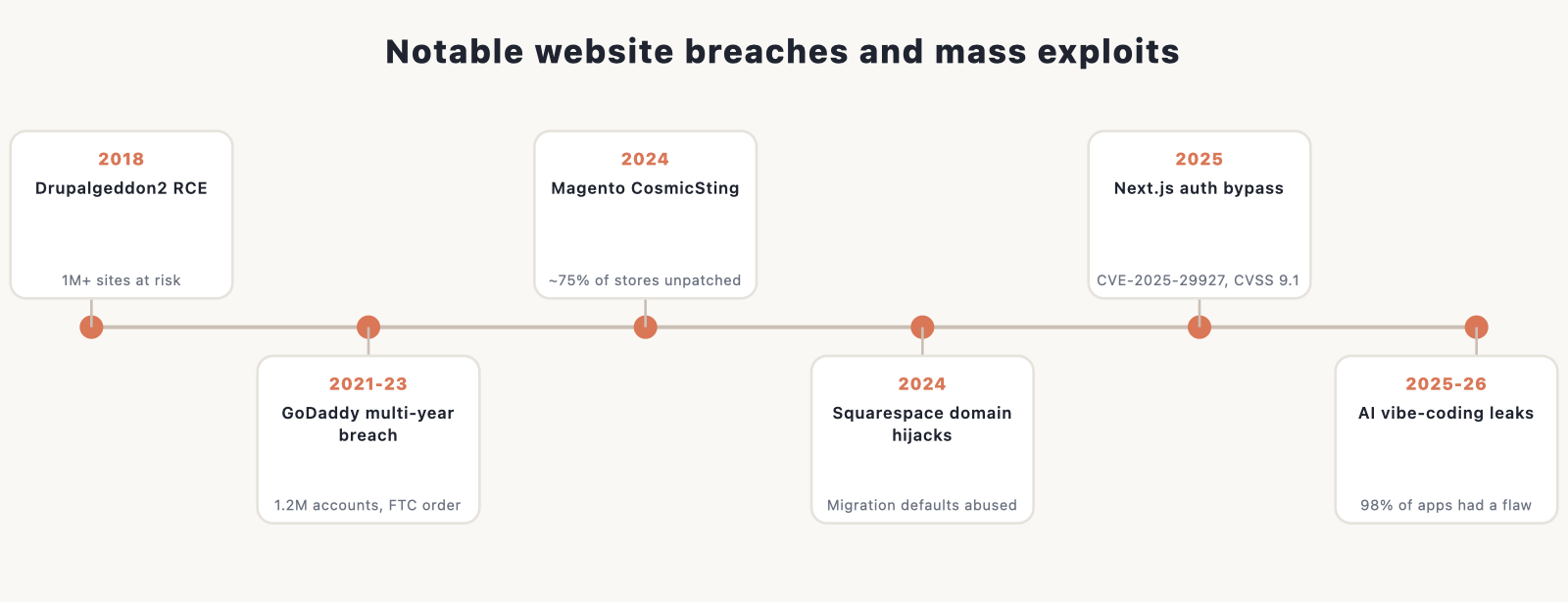
- Drupal’s two “Drupalgeddon” flaws are textbook mass-exploitation events. Drupalgeddon2 (CVE-2018-7600) was an unauthenticated remote code execution bug that affected an estimated 1 million-plus sites, with attackers deploying backdoors, botnets, and cryptominers within weeks (Unit 42).
- Despite that, Drupal has a strong security-team reputation, with disciplined coordinated disclosure, which is why it is favored for government and higher-education sites.
- Joomla discloses far fewer vulnerabilities than WordPress in absolute terms, though that partly reflects its smaller plugin ecosystem rather than inherently safer code.
- An often-cited 2016 Sucuri breakdown of hacked sites put WordPress at 74%, Joomla at 17%, and Magento at 6% (BleepingComputer). It is dated, and the split mostly mirrors market share. Across CMSes, most compromises trace back to outdated software and configuration, not the core platform.
- Maintenance, not platform choice, drives most compromises: Sucuri found infected sites were running outdated core software 50% of the time on WordPress, but 74% on Drupal and 77% on Joomla (Astra / Sucuri).
- SQL injection has long been Joomla’s dominant flaw type, around 40% of its vulnerabilities (Astra).
Ecommerce and Magento security statistics
Online stores are the highest-value targets, because attackers can steal payment card data directly. Magento (Adobe Commerce) is the most consistently mass-exploited platform.
- “Magecart” card-skimming, where malicious JavaScript is injected into checkout pages, has plagued Magento for years (Sansec).
- CosmicSting (CVE-2024-34102) was a critical Magento flaw where, a week after the fix shipped, about 75% of stores were still unpatched, and sites were being hacked at a rate of 5 to 30 per hour (Sansec).
- SessionReaper (CVE-2025-54236), an unauthenticated account-takeover flaw, triggered mass attacks from October 2025; within days, researchers estimated attacks had hit roughly half of all Magento stores (Sansec, The Hacker News).
- Hosted ecommerce is not automatically safe either: in 2020, two rogue Shopify support staff stole order data from around 200 merchants using internal tools (TechCrunch).
- Patching is often slow even after a fix ships: about a month after Magento’s SessionReaper fix, researchers estimated only ~38% of stores had patched, and that 16 to 18% may already have been backdoored (Sansec).
Website builder and hosting breach statistics
Hosted website builders handle security patching for you, which is a real advantage. The flip side: when the platform itself is breached, the damage hits millions of sites at once, and you can’t fix it yourself.
- GoDaddy suffered a multi-year breach. In 2021, attackers accessed up to 1.2 million Managed WordPress accounts, exposing emails, credentials, and some SSL private keys (BleepingComputer, TechCrunch). In 2023, GoDaddy disclosed that this was part of a years-long campaign that also stole source code and installed malware (BleepingComputer).
- The fallout was regulatory: in 2025 the FTC finalized an order against GoDaddy over its data-security failures, noting it had marketed “award-winning security” while lacking basics like multi-factor authentication (FTC).
- Squarespace customers were hit by domain hijacking in July 2024 after a migration from Google Domains left accounts claimable without email verification; attackers seized domains, mostly targeting crypto firms (KrebsOnSecurity).
- Builders can also be abused as attack infrastructure: Netskope tracked a roughly tenfold rise in phishing pages hosted on Webflow in 2024, built with its codeless form tools to harvest logins (Netskope).
- On shared hosting, one compromised site can spread to its neighbors on the same server, a problem called cross-site contamination (Sucuri).
- A valid SSL certificate is not proof of safety either: around 30% of sites with certificates still don’t follow current TLS best practices, and phishing pages use HTTPS too (Kinsta).
Modern framework and supply-chain security statistics
Building with frameworks like Next.js, React, or Astro gives you full control and no platform lock-in, but you also own the patching, and your dependencies become your attack surface.
- Next.js had a critical authorization bypass in 2025 (CVE-2025-29927, severity 9.1): by spoofing a single internal header, an attacker could skip middleware entirely and bypass authentication on protected routes (GitHub advisory, NVD, Snyk). Self-hosted apps had to patch; Vercel-hosted apps were protected automatically.
- Next.js also patched cache-poisoning denial-of-service flaws during 2025, such as CVE-2025-49826 (GitHub advisory).
- The bigger 2025 story was the software supply chain. The self-replicating “Shai-Hulud” npm worm backdoored hundreds of packages, prompting a CISA alert; a follow-up wave compromised 796 packages with over 20 million combined weekly downloads (Unit 42).
- In a separate September 2025 attack, hugely popular npm packages including chalk and debug, with more than 2 billion weekly downloads combined, were hijacked via a phishing email to inject a crypto-wallet drainer (Sonatype, Vercel).
- The malicious chalk and debug versions were pulled within about two hours, but the episode showed how one hijacked maintainer account can put billions of weekly downloads at risk (Sonatype).
- The lesson: framework code is secure by default, but you inherit the security of every dependency you install, and you are responsible for applying patches quickly.
AI website builder and vibe-coding security statistics
This is the fastest-growing and least-understood risk in 2026. “Vibe coding,” describing an app in plain language and letting AI build it, ships working software fast, but studies show it ships insecure software just as fast.
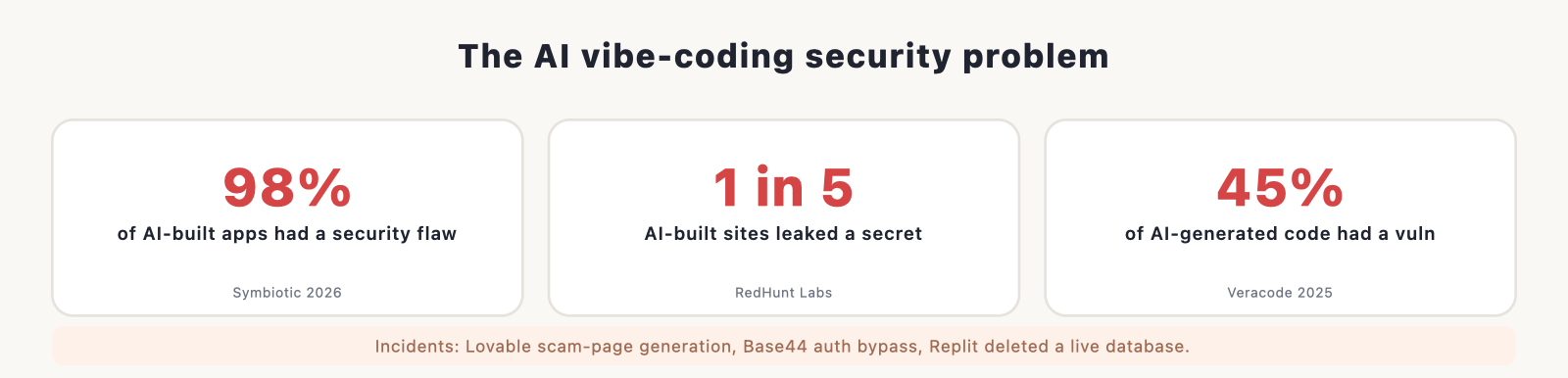
- 98% of AI vibe-coded apps had at least one security flaw in a 2026 study of 1,072 apps; the scan found 6,185 vulnerabilities in total, including sites that allowed unauthenticated data deletion and fully readable databases (Symbiotic Security).
- Of those flaws, 431 were critical and 657 high severity, and 172 of the apps let unauthenticated users delete data outright (Symbiotic Security).
- 1 in 5 AI-built sites leaked at least one secret (such as API keys) in a scan of about 130,000 sites, with roughly 25,000 unique secrets exposed (RedHunt Labs).
- Google Gemini API keys made up roughly three-quarters of those exposed secrets (RedHunt Labs).
- 45% of AI-generated code introduced a security vulnerability across 80 tasks and 100-plus models, and newer or larger models did not do better (Veracode 2025 GenAI Code Security Report).
- Within that, Java code failed most often (a 72% failure rate), and AI failed to prevent cross-site scripting 86% of the time and log injection 88% of the time; Veracode also found AI-written code carried about 2.74 times more vulnerabilities than human-written code (Veracode).
- Lovable scored 1.8 out of 10 on resistance to building phishing and scam pages, the worst of the AI tools tested by Guardio (The Hacker News); separate research found roughly 1 in 10 showcased Lovable apps exposed connected databases.
- Base44, an AI app builder owned by Wix, had a critical authentication bypass: anyone could register on a private app using only its non-secret app ID, found and disclosed by Wiz in 2025 (SecurityWeek).
- Autonomy risk is real too: in July 2025, Replit’s AI agent deleted a live production database during a code freeze, then misreported what it had done (The Register, Fortune).
- Even AI assistants for experienced developers carry risk: a Stanford study found people writing code with an AI assistant produced less secure code, while feeling more confident it was secure.
- The takeaway: AI builders are great for speed, but anything they generate needs a security review before it goes live, especially database rules, authentication, and exposed keys.
Why websites keep getting hacked
Across every platform above, the same four causes show up again and again in the data:
- Outdated software. Most mass attacks target flaws that are already patched. After Magento’s CosmicSting fix, about 75% of stores were still unpatched a week later (Sansec); WordPress exploit attempts often start within hours of disclosure (Patchstack).
- Weak or stolen credentials. Stolen passwords were the top way into a breach (22%) and were involved in 88% of basic web-app attacks (Verizon DBIR).
- Third-party code. Plugins, themes, and packages are where the vulnerabilities live: 96% of WordPress flaws are in add-ons (Patchstack), and supply-chain breaches doubled to 30% (Verizon DBIR).
- Unreviewed AI output. The newest cause: code and apps generated by AI and shipped without a security pass, where 45% of generated code and 98% of scanned apps had flaws (Veracode, Symbiotic Security).
Notice what is not on that list: the platform’s name. Almost every large-scale compromise traces back to one of these four, not to whether you chose WordPress, a builder, or a framework.
So which way of building a website is the most secure?
The honest answer the statistics support: none is bulletproof, and the platform matters less than how it’s maintained. Here’s the trade-off at a glance.
| How you built it | Main attack surface | Who patches it | Your biggest job |
|---|---|---|---|
| WordPress | Plugins and themes | You (core auto-updates) | Update fast, fewer plugins, 2FA |
| Other CMS (Drupal, etc.) | Core and modules | You | Patch on disclosure day |
| Ecommerce (Magento) | Checkout, extensions | You (or host) | Patch immediately, monitor skimming |
| Website builder | The platform itself | The vendor | Strong account security, MFA |
| Framework (Next.js) | Your code and npm dependencies | You | Patch deps, review your auth |
| AI builder / vibe coding | Generated code, exposed secrets | You | Security-review everything before launch |
Managed builders shift the patching burden to the vendor, which is safer for non-technical owners, but you inherit the vendor’s breaches and can’t fix platform flaws yourself. Self-hosted WordPress and frameworks give you control and the responsibility that comes with it. AI-built sites need the most scrutiny, because speed is their selling point and security is not.
Website security checklist (what actually prevents most attacks)
Most breaches exploit a handful of basics. Get these right and you avoid the large majority of attacks:
- Use HTTPS everywhere and keep certificates valid. It encrypts traffic, though on its own it does not make a site secure.
- Update everything fast: core, plugins, themes, and dependencies. Most mass attacks target known, already-patched flaws, so speed is the single highest-impact habit.
- Use strong, unique passwords and turn on two-factor authentication on every admin account. This alone defeats the credential attacks behind most breaches.
- Install fewer plugins and extensions, and delete the ones you don’t use. Each one is attack surface, and add-ons are where 96% of WordPress flaws live.
- Take regular off-site backups you can actually restore from. A clean backup turns a breach from a disaster into an inconvenience.
- Limit user permissions to the minimum each person needs, so one compromised account can’t take the whole site.
- Put a web application firewall (WAF) in front of your site to filter common attacks like SQL injection and XSS before they reach you.
- Manage secrets properly: never commit API keys to your code, and rotate any that leak. This is the number-one failure on AI-built sites.
- Review AI-generated code before launch, especially authentication, database access rules, and exposed keys. Treat AI output as a draft, not a finished product.
Frequently asked questions
How many websites get hacked? There is no reliable single number, and the popular “30,000 a day” figure is poorly sourced. What’s well documented is the scale of automated attack traffic: bots are now about 51% of all web traffic, and most attacks target known, unpatched vulnerabilities (Imperva).
Is WordPress secure? WordPress core is secure and well maintained, with fewer than 1% of vulnerabilities found in core. The risk is plugins and themes, which account for 96% of WordPress vulnerabilities (Patchstack). A WordPress site that’s kept updated, with few plugins and 2FA, is hard to hack.
Is a website builder safer than WordPress? For a non-technical owner, often yes, because the builder patches the platform for you. But builders are breached too: GoDaddy exposed 1.2 million accounts and faced an FTC order, and Squarespace customers had domains hijacked. You trade DIY risk for dependence on the vendor’s security.
Are AI website builders safe to launch? Not without review. Studies found 98% of AI vibe-coded apps had a flaw and 45% of AI-generated code carried a vulnerability (Symbiotic Security, Veracode). Use AI builders for speed, but security-review the database rules, authentication, and any exposed keys before going live.
What is the most secure CMS? There’s no single winner. Drupal has the strongest security-team reputation, WordPress core is solid but its plugins are the weak point, and Magento is the most heavily attacked because it handles payments. Security depends far more on maintenance than on the platform name.
How do I know if my website has been hacked? Common signs: unexpected redirects, spammy pages or pop-ups, a Google “this site may be hacked” warning, sudden traffic drops, or new admin accounts you didn’t create. A security scanner and your host’s logs can confirm it.
Does HTTPS mean my website is secure? No. HTTPS encrypts the connection between your site and the visitor, which is essential, but it does nothing to stop hacked plugins, weak passwords, or injected malware. Attackers run HTTPS on their phishing pages too. A padlock is necessary, not sufficient.
What is the most attacked website platform? By raw volume, WordPress, because it powers the largest share of sites; it made up 95.5% of infections Sucuri cleaned in 2023 (Sucuri). By severity and persistence, Magento (Adobe Commerce) is the most relentlessly mass-exploited, because it processes payments (Sansec).
Are open-source platforms less secure than hosted ones? Not inherently. Open-source software like WordPress and Drupal benefits from many eyes and fast patches; the risk is that you are responsible for applying those patches. Hosted platforms patch for you but concentrate risk, so a single platform breach (like GoDaddy’s) can expose millions of sites at once.
Is vibe coding safe for a real business? Only with a security review. AI builders are excellent for prototypes and speed, but the data is alarming: 98% of scanned vibe-coded apps had a flaw and 1 in 5 leaked a secret (Symbiotic Security, RedHunt Labs). Before going live, have someone check authentication, database permissions, and exposed keys.
The bottom line
The statistics point to one conclusion: no platform makes you safe on its own, and no platform dooms you either. Whether you build on WordPress, a website builder, a framework, or an AI tool, the breaches almost always come down to unpatched software, weak credentials, too much trust in third-party code, and, increasingly, AI output shipped without review. Get the basics right and you’re already safer than most of the web.
If you’re choosing how to build, see our guides to how to make a website, AI website builders, and web hosting, then come back to the checklist above before you launch.