How Many Websites Are There?
Last Updated: 07/29/26
As of 2026, close to 1.5 billion websites exist, though the total shifts daily as websites are launched or go dark. That sits below the 2021 peak of about 1.9 billion, yet the web keeps growing, and more than 5.5 billion people now spend part of each day online.
Quick answer: In 2026 there are close to 1.5 billion websites (about 1.49 billion, per Siteefy), but only around 15%, roughly 218 million, are active. The rest sit parked or dormant. Nearly 640,000 new sites launch each day, and more than 5.5 billion people are now online.
639,769 New Websites Per Day
| By the time you’re done reading this article: |
By the time your day ends: |
| 0 new websites | 100 new websites |
More than 35 years since it was born, the World Wide Web has completely transformed our lives. With a few clicks of your mouse or a simple voice command, you can have essentials delivered straight to your door or connect with a friend all the way across the globe.
Have you wondered what makes up the complex infrastructure of the Internet or interconnected World Wide Web? What sites dominate our online searches? And, just how vast is the network that we use and rely on daily for information?
To attempt to answer these insurmountable questions, we’ve compiled everything to know about what makes up the Internet and Web and why this information matters for you and users around the world as these systems grow.
-
Chapters
-
How Big is the Internet?
-
Facts About the Internet
-
Internet Statistics
-
Number of Active Websites
-
Types of Websites
-
Most Visited Websites
-
Future of the Internet

How Big is the Internet?
Even for complex data analysts, it’s difficult to get an accurate picture or truly understand how big the Internet and World Wide Web is.
Beyond the ever-changing “surface” web is the unquantifiable dark web or invisible web. The dark web is estimated to be a thousands times larger than the surface web, and each is growing by the day. Just think: in the minutes it takes you to read this, hundreds to thousands of new sites may be born.
We use the Internet in real-time now more than ever, whether it’s with streaming content or video calls. Meaning, the networks we use have become more aware of how to operate, deliver, and prioritize information than ever before.
Will we ever reach full capacity? While the answer is impossible to predict, there are ways to attempt to quantify how big the Internet is with the questions below.

How Much Data
is on The Internet?
To estimate the size of the Internet, we can look at how much data there is in the world. Statista projects that the volume of data created, captured, and consumed worldwide will reach roughly 181 zettabytes (ZB) in 2025, up from about 64 ZB in 2020.
TechTerms defines a zettabyte as “1021 or 1,000,000,000,000,000,000,000 bytes.” On a grander scale, one zettabyte is “approximately equal to a thousand exabytes, a billion terabytes, or a trillion gigabytes.”
If you compare how many terabytes are in a zettabyte, you can get a picture of just how large a zettabyte is and in turn, the size of the Internet. A Cisco analyst calculated that “if each terabyte in a zettabyte were a kilometer, it would be equivalent to 1,300 round trips to the moon and back.”

How Many Web Pages Exist?
According to WorldWideWebSize, the indexed web held at least 3.98 billion pages as of January 2025. That figure counts only pages the major search engines have crawled and indexed, so the real total is far higher.
Web page vs. website
A web page is any single page on the Internet that can include a range of content from video to text, while a website is a collection of web pages under one domain.
Let’s consider an example. Nike is one of your favorite brands to shop online, but the women’s running shoes product page is the page you frequent the most. The Nike site as a whole is the website, while women’s running shoes is one of the web pages that makes it up.

How Many People Use the Internet?
Internet Live Stats and DataReportal put the number of internet users at more than 5.5 billion, over two thirds of the global population. That reach shows how large the Internet has become, with billions of people browsing from a phone or laptop every day.

How Long
Would it Take to
Download The Web?
According to Physics.org, it’s estimated to take “three million years to download all the information currently on the internet, assuming a download speed of 44 megabits per second.”

Facts About the Internet
How much do you really know about what powers our digital world? The Internet and Web have truly revolutionized how we connect with each other. Let’s take it back to the beginning and define some of the most important milestones and terms to know.
World Wide Web vs. Internet
While the Web and Internet are intricately connected and many people use the terms interchangeably, they are actually two different things.
Think of the Internet as a network consisting of infrastructure and technologies that you use to connect whether it’s at your office, home, or a coffee shop.
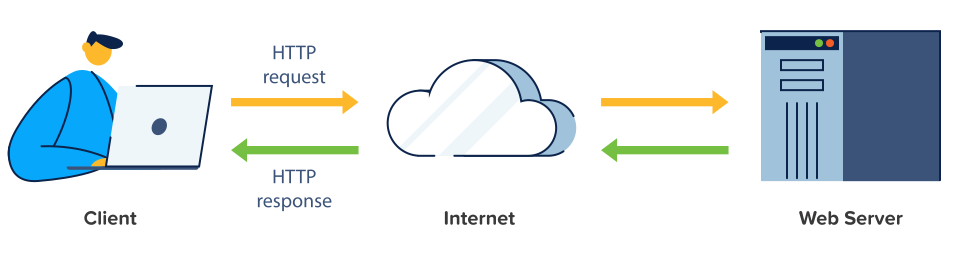
The World Wide Web (or Web) is the system that enables the exchange of information over the Internet through HTTP, essentially what powers the technology.
When Was the Internet Created?
The Internet was created in 1989 by Tim Berners-Lee, who’s now considered the inventor or “Father” of the Internet. He now leads the W3C which is the organization that oversees the development of the World Wide Web.
How Was the Internet Created?
Berners-Lee developed hypertext, the method of instant cross-referencing that supports communications on the Web, making it easy to link content on one web page to content located elsewhere. The introduction of hypertext revolutionized the way people used the internet. With that, he introduced the first browser and editor, as well as HTTP/HTML protocols.
What Was the First Website?
The very first website was info.cern.ch and went live in 1991 to provide information on the World Wide Web Project led by Berners-Lee.
Did you know the first website is still live today? You can check it out here:
https://info.cern.ch/hypertext/WWW/TheProject.html
How Many Websites are Created Everyday?
There is no exact answer, but Siteefy estimates that close to 640,000 new websites are added each day in 2026, which works out to roughly 444 per minute, or about 7 every second. If you want to join them, here is how to build your own website.

Internet Statistics
In one day across the world, it’s estimated that there are:

Over 5.5 billion
Internet users

Over 13 billion
Google Searches

70,000+ websites hacked

Over 330 billion
emails sent

Billions of gigabytes of Internet traffic
Internet Users by Country
It comes as little surprise that internet users spend an average of 6 hours and 38 minutes online each day.
Our daily lives center around logging in online, regardless of the device. Below is a breakdown of the top 5 countries with the most internet users.
China
1,110
million+ users
India
806
million+ users
U.S.A.
322
million+ users
Indonesia
212
million+ users
Brazil
183
million+ users
Source: Statista (2025)
How Many People Use Google?
Google now handles an estimated 5 trillion searches per year, its first official volume update since 2016. The search engine still dominates online discovery and ranks as the most visited website in the world, pulling in tens of billions of visits each month.
Internet users still favor Google, which dominates the search engine market with a market share of about 90% as of 2025.
Mobile Users
Mobile devices now drive about 62% of global Internet traffic. People across the world are more mobile than ever, using their smartphones for a quick search, to make a purchase, or to connect on social media.
As of 2025, over 4.9 billion people own a smartphone, and mobile devices now account for well over half of the time the world spends online.

Number of Active Websites
While close to 1.5 billion websites exist, only about 218 million are active, according to Siteefy. That total lines up with the Netcraft December 2025 Web Server Survey, which counted about 1.39 billion sites across 292 million domains. The remaining 85% sit inactive as parked domains, redirects, expired projects, or placeholder pages left up by hosts.
How Many Domains are There?
Verisign reported 386.9 million registered domain names at the end of the fourth quarter of 2025, up 6.2 percent year over year. The .com and .net extensions held a combined 173.5 million registrations, with .com still the most widely used.
Types of Domains
Every domain name operates under a Domain Name System (DNS), which directs visitors to your website by translating the name into its related IP address and locating where the resource is stored.
Top level domains (or TLDs) are at the highest level in the DNS structure of the Internet. Check out the very first TLDs to be introduced and which are most commonly used today.
| Domain | Short for | How it’s used |
| .com | Commercial | All types of businesses, most popular and widely used |
| .net | Network | Commonly used for various businesses or organizations |
| .edu | Education | Colleges, universities, and other educational institutions |
| .org | Organization | Non-profits, various communities, and schools |
| .gov | Government | Governmental agencies, programs, states, cities, and more |
| .mil | Military | Military branches |

Types of Websites
Websites are separated into two different types: static and dynamic.

Static Websites
A static website is the most basic and easiest type of website to create. It’s made up of pages that have fixed content coded in HTML. It displays the same information to its site visitors.
Unlike dynamic websites, static websites don’t require programming or database design. A static site can be built by simply creating a few HTML pages and publishing them to a server.
Static sites have:
- No users or comments
- No interactivity
Dynamic Websites
Dynamic websites contain web pages that access information from a database and are generated in real-time. Compared to static websites, a dynamic site is more functional.
These pages include Web scripting code, such as PHP or ASP. When a dynamic page is accessed, the code within the page is parsed on the Web server and the resulting HTML is sent to the client’s Web browser.
Content management systems (CMS) such as WordPress make it easy to build a dynamic site. As of 2025, W3Techs reports that WordPress powers about 43% of all websites and holds roughly 61% of the CMS market. Dynamic sites suit large projects with many pages, since different people can update content without touching the page layout.
Common examples include:
- E-commerce sites
- Blogs

| Static |

Basic, fixed number of pages |

Can be built in plain HTML |

No use of database |
| Dynamic |

More interactive and functional |

Based on HTML and CSS, with server-side scripting |

Database used |

Most Visited Websites
Which site do you frequent the most? It’s no surprise that there are commonalities in the most visited websites around the world.
Big names dominate online queries, and they likely bubble to the top of your mind or search box without a second thought. As of 2026, Semrush ranks the ten most visited websites in the world by monthly visits like this:
- Google.com, about 111.8 billion monthly visits
- YouTube.com, about 54.4 billion
- Facebook.com, about 10.9 billion
- Instagram.com, about 7.2 billion
- ChatGPT.com, about 6.2 billion
- Reddit.com, about 5.8 billion
- Wikipedia.org, about 4.9 billion
- X.com, about 4.4 billion
- WhatsApp.com, about 3.1 billion
- Yahoo.com, about 2.6 billion
The detailed tables below show an earlier snapshot from 2020 (organic search traffic, via Ahrefs), so you can see how the order has shifted since AI tools like ChatGPT climbed into the top five.
| Domain | Monthly traffic |
 YouTube YouTube |
1,625,928,544 |
 en.wikipedia.org en.wikipedia.org |
1,032,257,682 |
 Twitter Twitter |
535,672,329 |
 Facebook Facebook |
512,517,207 |
 Amazon Amazon |
492,468,801 |
 Yelp Yelp |
189,284,057 |
 Reddit Reddit |
184,283,420 |
 IMDb IMDb |
168,686,113 |
 Fandom Fandom |
168,358,254 |
 Pinterest Pinterest |
160,008,934 |
| Domain | Monthly traffic |
| YouTube |
8,564,946,885 |
| Facebook |
3,483,131,264 |
| en.wikipedia.org |
2,223,668,855 |
| Twitter |
2,008,820,315 |
| Amazon |
618,747,155 |
 Google Play Google Play |
594,678,708 |
 Instagram Instagram |
525,400,578 |
| es.wikipedia.org |
450,521,278 |
| Pinterest |
419,840,135 |
 Live.com Live.com |
419,057,040 |
Source: Ahrefs (2020 snapshot) plus Semrush (2026)
Most Popular Websites: Then and Now
How have some of the most popular sites we know and love evolved over the years? Let’s take a look at what the top five sites looked like 10 years ago, compared to now.
YouTube
Wikipedia
Amazon
Source: Internet Archive

Future of the Internet
The Internet is one of the fastest growing and transformative technologies. Still, history is in the making as digital life continues to advance and evolve each year, making even the wildest dreams become reality. What’s in our future?
Think Virtual Reality

Merge augmented reality (AR) and virtual reality (VR) to create a new user experience

Experience life on Mars with a new interactive VR experience from NASA
Interact with VR through handheld devices, instead of motion sensing devices
Transport healthcare patients to conflict situations to help resolve phobias or fears
Revolutionize shopping experience with VR changing rooms and AI shopping assistants
New Forms of Technology

Rise in predictive technologies such as omnipresent autocorrect

Use of neutral avatars for hiring and employment selection

Beginnings of neuro-engagement such as gesture and gaze tracking

Artificial intelligence (AI) will take over labor tasks leaving people with more time for leisure
What will the next decade hold and how will it change our lives? Wired stated, “At its core, if the 2010s have been all about software,” then the “2020s might be the moment when infrastructure reclaims centre-stage.” The Cisco EVP and GM David Goeckeler stated it best, “The key promise of the Internet of the future is that no one gets left behind this time.”
Sources: Siteefy | Netcraft | Internet Live Stats | Verisign DNIB | W3Techs | StatCounter | DataReportal | Statista | Semrush | WorldWideWebSize