 Making money from your website isn’t a myth. It’s doable by anyone.
In fact – turning a part-time, hobby blog or website into an income-generating asset is fairly common with a bit of persistence and some hard work.
At the very least, you should be able to make enough to cover your basic expenses for a domain and web hosting – which are essential for keeping your website up and running.
You might even be able to replace your income (and then earn some more).
Keep in mind that the strategies listed below range from easy and passive, to the ones which require a ton of ongoing work (so make sure you pick something that suits your site and lifestyle preferences).
There are 30+ total tips in this guide, but let’s start with the fourteen most popular (and proven) site monetization methods.
If you still don’t have a website but you wish to create one that you also plan to monetize, you can start by using this step-by-step guide on how to create your own website at the cheapest cost.
14 Best Ways to Make Money with Your Website
Making money from your website takes effort and patience. These fourteen methods are your best bet to get started – pick the ones that match your site, your skills, and your audience.
1. Affiliate Marketing
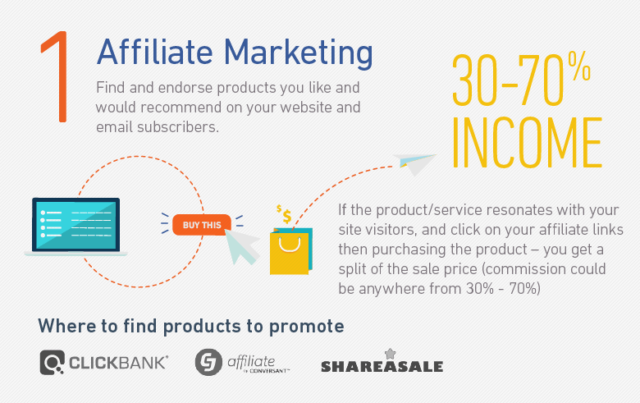
Affiliate marketing is one of the most popular (not to mention quickest) ways to make money from your website or blog.
Start by finding a product you like and would recommend. Then on your website, you endorse the product and promote it to your website visitors and email subscribers. If the product or service resonates with these people, they’ll click on your affiliate link, purchasing the product (while you get a split of the sale price).
The commission might be anywhere from 5% up to as high as 70%, depending on the product type and affiliate program.
For example, if the split is 50% and you promote an e-book that costs $100, you’ll get $50 for simply referring the buyer. Pretty sweet deal, huh?!
Here are some tips to make affiliate marketing work for you:
- Only promote products you genuinely trust. Your readers will notice if you recommend something just for the commission – and it’ll hurt your credibility.
- Incorporate affiliate links naturally into blog posts, product reviews, or comparison guides rather than forcing them in.
- Track your performance with tools like Google Analytics to see which links drive the most clicks and conversions.
- Be transparent and disclose your affiliate relationships. In the US, the FTC requires this – and it’s the right thing to do regardless.
Where Can I Find Products to Promote?
- CJ Affiliate (formerly Commission Junction) – offers reliable products with on-time payments.
- ShareASale – a wide range of merchants across many categories.
- Clickbank – high percentage payouts, especially strong for digital products.
- Amazon Associates – lower commissions, but huge product selection and high trust factor.
2. “Pay Per Click” Advertising (Google AdSense)
Displaying ads on your site is one of the easiest and most hands-off ways to generate income. Among the different ad networks available, Google AdSense is the most widely used and trusted platform for publishers.
The best part about this system is how simple everything is.
Once you sign up, Google will place a simple code on your website that will identify the content of your site and start displaying relevant advertisements. For example, if your site is about pets (dogs & cats), Google AdSense will start showing your visitors ads for cat food, dog training, and more.
You get paid each time someone clicks on the ad. (Yes, it’s really that easy!)
Your cut can vary a lot depending on your niche and audience. Some sites earn pennies to a few dollars per click, while many publishers focus more on overall revenue per 1,000 pageviews (RPM) rather than per-click rates. For context, Google AdSense’s revenue share for AdSense for Content works out to about 68% to the publisher when ads are bought through Google Ads. Once your site has steady traffic, it’s realistic to earn hundreds – and sometimes thousands – of dollars per month from ads.
How to Apply for Google AdSense?
- Apply for AdSense – Before applying, make sure you keep up with their latest Terms Of Service. Google has strict rules, so it’s important to have quality content and a clean site design before you apply.
- Place ads strategically in high-visibility areas like within blog posts or at the top of sidebars.
- Focus on growing organic traffic through quality content – more visitors means more potential clicks.
3. Sell Ad Space
Incorporating Google’s AdSense on your website is just one way to make money from online advertisements.
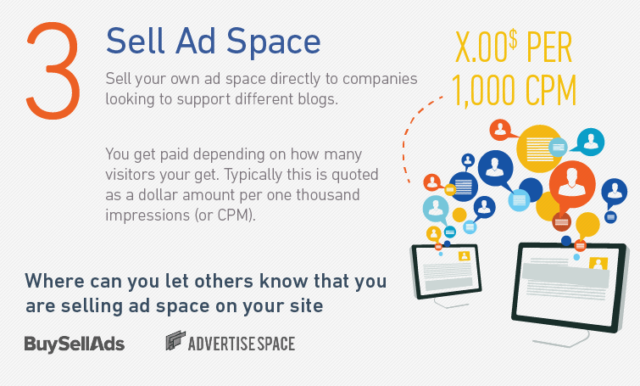
Another is to sell your own ad space directly to companies looking to sponsor different blogs. You can come up with a price for each space, for example: “Sidebar banner ads will cost $xxx per month”.
You can get paid depending on how many visitors you get. Typically it’s quoted as a dollar amount per one thousand impressions (or CPM). You might see it as $5 CPM. If the website gets 100,000 visits a month, that ad price translates into $500 bucks.
The good thing about this approach is that if your site gets a ton of traffic from different sources, your simple banner ad pricing can go up to as high as $5000 per month! The obvious downside is that if your site doesn’t get a lot of traffic, you can’t expect to earn much either.
The other common method when selling ad space directly from your website is a simple direct price. You simply name a price (based on what you think it’s worth, relative to what the competition might be charging), and get paid upfront at the beginning of each month. This pricing is also generally a simple flat fee, not tied to a Cost Per Click like AdSense.
To sell ad space effectively, consider creating a simple media kit that includes your traffic stats, audience demographics, and available ad placements with pricing. This makes it easy for potential advertisers to say yes.
Where Can I Let Others Know That My Website Is Selling Ad Space?
- BuySellAds – A popular environment to let advertisers know you’re selling ad space.
- You can also reach out directly to companies in your niche or add an “Advertise With Us” page on your website.
4. Sell Your Own Digital Product (E-Book for Example)
You have the potential to make the most money on a per-sale basis when you can sell your own directly.
That’s because there’s no middle-man or person in between you and the buyer that’s taking a ‘cut’ from the money earned.
This approach seems fairly straightforward because you can simply sell these products directly through your website and get paid immediately. Unfortunately, it’s not that simple in reality.
Creating good products that are well made and polished requires a ton of time and additional resources (like design, content, etc.). There’s a lot of ‘hidden costs’ in both time spent and the contractors to collaborate with. Selling your own products on your site also brings up problematic issues like payment gateways, shipping, and taxes.
If it doesn’t sound like enough work already, you’ll also need a well-designed, persuasive landing page to make sure your product has a strong conversion rate.
Popular digital products you can create and sell include:
- E-books and guides
- Templates and printables
- Stock photos or graphics
- Software tools or plugins
- Audio files or music
The upside? Once a digital product is created, you can sell it over and over with virtually no additional cost per sale.
For Further Reading:
5. Accept Donations From Visitors
If you don’t have a ton of monthly visits, but you do have a strong, engaged community? Simply ask your readers to donate!
Accepting one-off donations isn’t a fast road to wealth, but it can help you cover expenses in the short-term if people like what you have to say and want to support your journey.
For example, PayPal offers little donation buttons that only take about ten minutes to add to your website. These buttons offer you a quick way to recoup what you might want to be spending on a good web hosting, new product creation, research, and all of the other costs to maintain a healthy, active blog.
You can also consider platforms like Buy Me a Coffee or Ko-fi, which make it easy for supporters to contribute small amounts. Some sites even offer subscription-based donation models where supporters contribute a recurring monthly amount.
Setting clear goals (like “Help us cover hosting costs this month”) and offering small incentives like exclusive content or shoutouts can further motivate donors.
How to Set Up Donation Buttons?
6. Sell Sponsored Posts (…but Use Nofollow Tag)
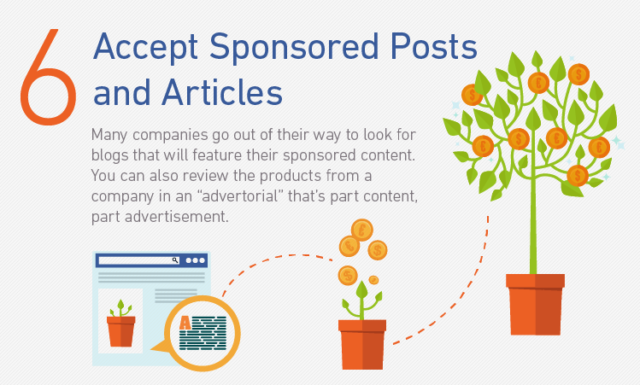
One of the common ways to make more money from your website means getting those visitor numbers up.
Once you’ve done the hard work of building steady traffic to your site with an engaged community, there are a few different ways to monetize your hard work.
For example, many companies go out of their way to look for blogs that will feature their sponsored content. ‘Native advertising‘ like this works well because it lines up with your site’s primary content and it comes across as relevant and transparent.
You can also review the products from a company in an ‘advertorial’ that’s part content, part advertisement. For example, if your website is all about the latest iOS games for iPhones and iPads, the creator of one of those apps would love to have you review and feature their app to your fans.
When done right, this can create a win/win scenario. However – done poorly, with irrelevant or inauthentic site content, it can erode all of the reader’s goodwill you’ve worked so hard to create in the first place.
Here are a few tips for sponsored content success:
- Always be transparent with your audience about sponsored posts – it’s both ethical and legally required in most countries.
- Only accept sponsorships from brands that align with your niche and that you’d genuinely recommend.
- Make sure your regular, non-sponsored content always outnumbers sponsored posts by a wide margin.
- Focus on quality over quantity – one well-crafted sponsored article is worth more than five lazy ones.
7. Generate ‘Leads’ for Other Companies
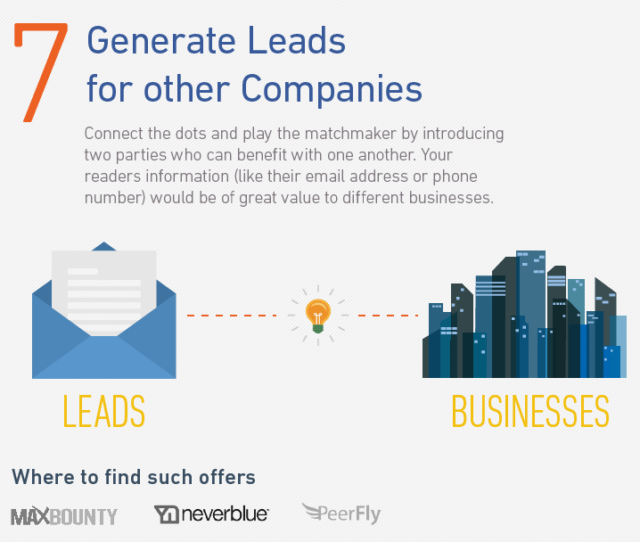
Businesses thrive on new leads coming in their doors to inquire about their products or services.
It’s no surprise that they’re always on the lookout, searching for creative ways to find new sources of leads to help them grow.
For example:
Let’s say you have a website about teaching math skills. Your reader’s information (like their email address or phone number) would be of great value to different online schools who’re looking to sell their courses to eager, proactive students.
Basically, you’re connecting the dots; playing the matchmaker by introducing two parties who can benefit one another. While it’s similar to how affiliate marketing works, in this case, it doesn’t actually matter if your reader ends up purchasing their product or not. They’re just looking for an introduction at this point.
Where Can I Find Such Offers?
- CJ Affiliate – many lead generation offers available across niches.
- FlexOffers – a large network with pay-per-lead opportunities.
8. Build an ‘Email List’
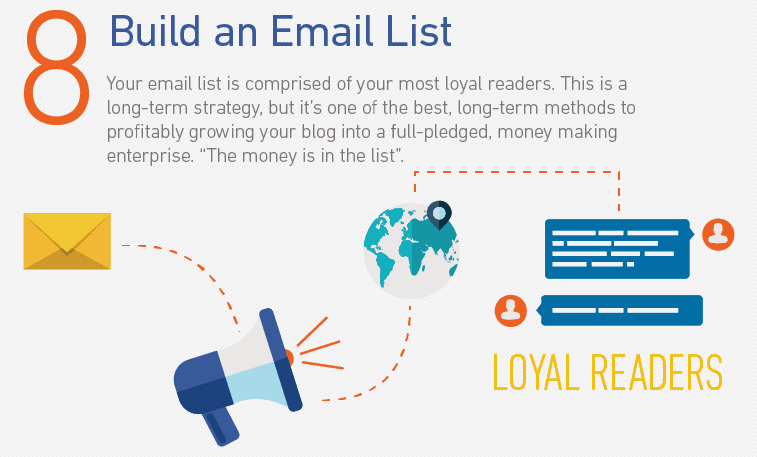
Spend any amount of time reading blog growth tips, and you’re sure to come across people saying “the money’s in the list“.
They’re referring to your email list, which comprises your most loyal readers. The objective is to convert as many strangers who visit your site for the first time into passionate followers who want to stay up-to-date on your latest work or content.
Admittedly this is a long-term strategy (and you definitely won’t get rich overnight). But it’s one of the best, long-term methods to profitably growing your blog into a full-fledged, money-making enterprise.
An email list gives you a direct line to your audience – one that isn’t dependent on social media algorithms or search engine rankings. You can use it to promote your products, share affiliate offers, announce new content, or simply nurture relationships that lead to revenue down the road.
Never lose sight of creating relationships with your followers. Offering great information or free help is a perfect way to start. Spamming people with unsolicited offers is one of the fastest ways to abuse the reader’s trust and sabotage your long-term goals.
How Does It Exactly Work?
9. Set Up an eCommerce Site
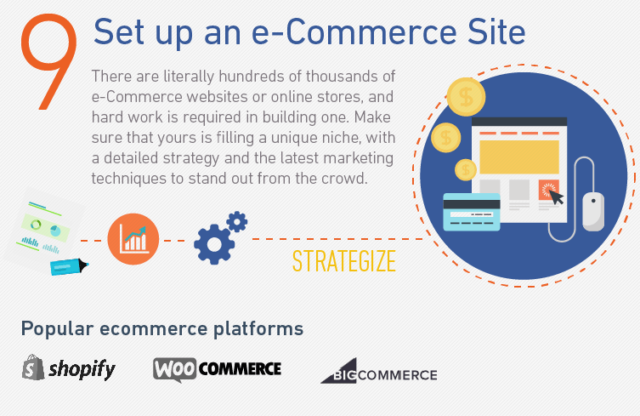
Websites don’t just have to be about content. They can be centered around tools or products on an online store.
Be forewarned:
There are literally hundreds of thousands of eCommerce websites or online stores. Make sure that yours is filling a unique niche, with a detailed strategy and the latest marketing techniques to stand out from the crowd.
You have several options for setting up shop:
- Use a dedicated eCommerce platform like Shopify for an all-in-one solution.
- Add WooCommerce to your WordPress site if you already have one running.
- Sell digital products with minimal overhead (no shipping or inventory required).
- Try dropshipping if you don’t want to manage inventory – a third-party supplier handles fulfillment while you focus on marketing and sales.
Whichever path you choose, make sure your store has high-quality product images, clear descriptions, secure payment options, and a mobile-friendly design.
How Do I Create a Successful Online Store/Shop?
10. Flip Your Websites (Create -> Sell -> Reinvest)
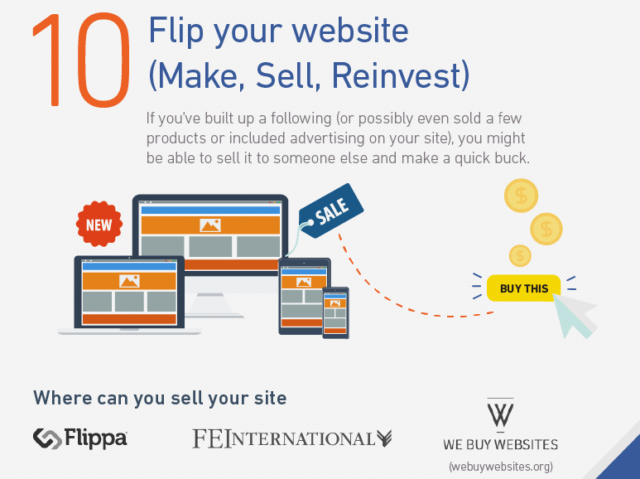
Believe it or not, there’s almost always a market out there for your website.
That means if you’ve built up a following (or possibly even sold a few products or included advertising on your site), you might be able to sell it to someone else and make a quick buck.
To be honest, we typically don’t suggest people plan on flipping their website or blog (we’re a bigger fan of creating something for the long-term).
You can’t deny how lucrative it can be. For example, if your website is making $500 per/month through selling ad space, you might be able to sell the site for $5,000 – $10,000 (which is roughly 10x – 20x monthly income, depending on the niche and growth trajectory).
You can also approach flipping from the other direction: buy an underperforming website, improve its content, design, and SEO, and then sell it at a profit. Think of it like house flipping, but for digital real estate.
Where Can I Sell My Site?
- Flippa – The most popular website marketplace.
- Empire Flippers – A curated marketplace, especially good for established sites.
- FE International – Mostly for higher-end websites.
11. Create and Sell Online Courses
If you’re knowledgeable about a specific topic, packaging that expertise into an online course can be one of the most rewarding (and scalable) ways to monetize your site.
There’s always demand for online courses that teach valuable skills – whether that’s web development, photography, cooking, personal finance, or anything in between. The key is to create a course that matches your expertise and solves a real problem for your audience.
You can charge a one-time fee for access, set up a subscription model, or even offer tiered pricing with different levels of content.
Here’s how to get started:
- Pick a focused topic that your audience actually wants to learn about. Check what questions they ask you most frequently.
- Structure your course into clear modules or lessons that build on each other.
- Keep lessons concise and focused – students stay more engaged with shorter, digestible content.
- Use a platform like Teachable, Thinkific, or even WordPress with a learning management system (LMS) plugin to host your course.
- Include quizzes, assignments, or certificates of completion to boost the perceived value.
- Consider offering a free preview or mini-course to demonstrate value before asking people to pay.
Once your course is live, it can generate passive income for months or even years – especially if you promote it through your email list and existing content.
12. Start a Membership Site
A membership site lets you charge a recurring fee for access to premium content, exclusive resources, or a private community. This model works especially well if you consistently produce valuable content that people are willing to pay for.
You can offer exclusive articles, videos, downloadable resources, or even a members-only forum where your community can connect and learn from each other.
Here are some common membership models:
- All-in membership: Members get access to everything at once for a monthly or annual fee.
- Drip-feed membership: Content is released gradually over time, keeping members engaged long-term.
- Tiered membership: Different price levels unlock different amounts of content or benefits.
Tips for making it work:
- Consistently publish new content to justify the recurring fee.
- Consider offering a free trial or freemium tier to get people in the door.
- Keep the sign-up and cancellation process simple and transparent.
- If you’re on WordPress, plugins like MemberPress or Restrict Content Pro make setting this up relatively straightforward.
The recurring revenue model is one of the biggest advantages here – instead of one-time sales, you’re building a predictable monthly income.
13. Offer Consulting or Coaching Services
Most of us have unique skills or expertise that others can benefit from. If you’ve built credibility through your website’s content, offering consulting or coaching is a natural next step.
This doesn’t require fancy tools or a big upfront investment. You can offer one-on-one sessions via Zoom or Skype, group coaching calls, or even asynchronous consulting via email.
Here’s how to get started:
- Clearly define what you’re offering and who it’s for. “I help small business owners set up their first WordPress site” is much stronger than “I do web consulting.”
- Add a dedicated page to your website with your services, pricing, and a way to book sessions (tools like Calendly make scheduling easy).
- Showcase testimonials or case studies from past clients to build trust.
- Start by offering a free 15-minute discovery call to attract your first clients.
Consulting tends to be one of the higher-paying monetization methods because you’re selling your time and expertise directly. It’s a great way to earn income while other passive revenue streams (like affiliate marketing or ad income) are still building up.
14. Send a Premium Newsletter
Email newsletters have made a huge comeback. If you have valuable insights to share regularly, a paid newsletter can become a reliable income stream.
The idea is simple: offer a free version of your newsletter to build your subscriber base, and then provide a premium tier with deeper insights, exclusive analysis, or bonus resources that subscribers pay for.
Platforms like Substack, ConvertKit, or Mailchimp make it easy to set up both free and paid tiers. You can charge a monthly or annual subscription fee.
Tips for making it work:
- Focus each edition on a specific, timely topic that genuinely interests your audience.
- Be consistent with your publishing schedule so subscribers know when to expect it.
- Start with a free version to prove value before introducing the paid tier.
- Keep the content exclusive – if people can find the same information for free on your blog, they won’t pay for the newsletter.
By now we have counted down the most popular and effective ways to earn money from your website.
Yet, we’re still only just scratching the surface.
Below are more ways to make money with your website.
(Keep in mind that some of them are slightly connected with the ones above yet they are a little ‘out of the box‘.)
More Ways to Monetize Your Website
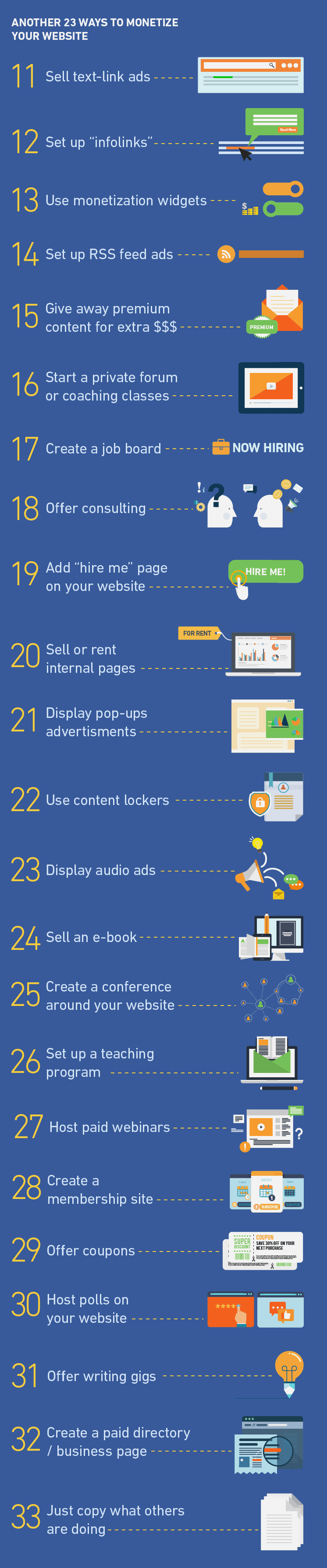
15. Sell text-link ads (NOT RECOMMENDED) – There’s still a demand for text-link ads (believe it or not). But please keep in mind that these violate Google’s Terms of Service (which means you run the risk of getting penalized). To avoid it, simply keep the “nofollow” tag.
16. Give away premium content for an extra $$$ – If you are producing mind-blowing, awesome content that visitors can’t get enough of, you can always try asking them to pay for some of it! Bear in mind – don’t ask people to pay right away. Instead, stay focused on growing an audience and visitors first.
17. Create a job board – Setting up a job board on your website is another simple way to collect additional revenue when companies or individuals pay to post their job listings.
18. Add the “Hire Me” page on your website – Your new website or blog is also a perfect place to feature your freelancing services. Showcasing samples, an online portfolio, and testimonials from past clients will help greatly increase your chances of getting hired. Add a clear call-to-action button and a contact form to make it easy for potential clients to reach you.
19. Sell or rent internal pages – These aren’t very common, but you might be surprised at what people would be willing to rent or spend money on!
20. Use content lockers – ‘Content locking’ is similar to hiding or protecting pieces of content until a visitor takes some action to redeem them. For example, maybe you want them to share your post on social media, sign up for your email list, or complete a quick survey.
21. Write and sell an e-book – This one is a no-brainer. If you have a website about recipes and cooking, you can easily create and sell your own recipe book. The same applies to almost every niche. Since there’s no publisher between you and the buyer, you keep all the profits.
22. Create a conference or live event around your website – Lots of work, but a huge potential payoff. If you’ve built a strong community, they may be willing to attend (and pay for) an in-person or virtual event.
23. Host paid webinars – Package your expertise into live or recorded online workshops. Webinars are relatively easy to set up using platforms like Zoom or Vimeo, and you can charge for attendance or offer them as part of a membership.
24. Offer coupons (with affiliate links) – People are eagerly looking for discount & promo codes for everything from clothes to travel vacations. If you can find and offer a valid one, you can also get a cut of that revenue through your affiliate link.
25. Offer writing or freelance gigs – You can earn money writing content for other companies or individuals. There’s also a huge demand for fluent speakers of different languages, as many companies want their websites translated by native speakers.
26. Create a paid directory or business page – You charge businesses for listing in your directory or subscribing to the page. This works particularly well in local or niche markets.
27. Try dropshipping – Dropshipping lets you sell products without managing inventory. When a customer orders from your site, a third-party supplier ships the product directly to them. It takes little investment to start and gives you flexibility in your product offering.
Tips to Maximize Your Website Revenue
No matter which monetization methods you choose, there are a few universal strategies that’ll help you earn more:
- Focus on quality content first. Every monetization method works better when your site provides genuine value. Great content attracts traffic, builds trust, and keeps people coming back.
- Invest in SEO. Organic search traffic is one of the most valuable (and free) sources of visitors. Learn how to drive more traffic to your website so your monetization efforts have more fuel.
- Don’t rely on a single income stream. The most successful website owners combine 2-3 monetization methods (e.g., affiliate marketing + an email list + a digital product).
- Be patient. Most websites take at least 3-6 months before generating meaningful income. Focus on growing your audience first, and the revenue will follow.
- Track your results. Use tools like Google Analytics to understand what’s working and what isn’t. Double down on the strategies that are driving actual revenue.
- Leverage AI tools. AI-powered tools can help you optimize content, automate email marketing, analyze trends, and identify high-converting products. Use them to work smarter, not harder.
Frequently Asked Questions
How much traffic do I need to monetize my website?
There’s no magic number. Some monetization methods (like selling your own products or offering consulting) can work with just a handful of dedicated visitors. For ad-based revenue (like Google AdSense), you’ll generally need at least 50-100 daily visitors to see meaningful results. The quality and engagement of your audience often matters more than sheer volume.
How long does it take to make money from a website?
It depends on your monetization method and how much effort you put in. Most website owners start seeing some income within 3-6 months. Advertising and affiliate income typically take longer to build up because they depend on traffic growth. Selling products or services can generate revenue faster if you already have an audience.
Can I monetize a free website?
It’s possible, but limited. Free website platforms often restrict your ability to run ads, use custom code, or add eCommerce features. For serious monetization, you’ll want your own domain name and a reliable web hosting plan – which can cost as little as a few dollars per month.
What’s the best way to monetize a website for beginners?
For most beginners, a combination of affiliate marketing and Google AdSense is the easiest starting point. They require no upfront investment, no product creation, and can be set up relatively quickly. As your traffic and audience grow, you can layer in additional methods like digital products, courses, or membership content.
How much money can I realistically make from a website?
It varies enormously. Some hobby bloggers make $100-500/month to cover their expenses, while established websites can generate $5,000-$50,000+ per month. Your income potential depends on your niche, traffic volume, audience engagement, and which monetization methods you use. The key is to start, stay consistent, and reinvest in growing your site.
P.S. If you wish to use this infographic on your website, feel free to do so.