
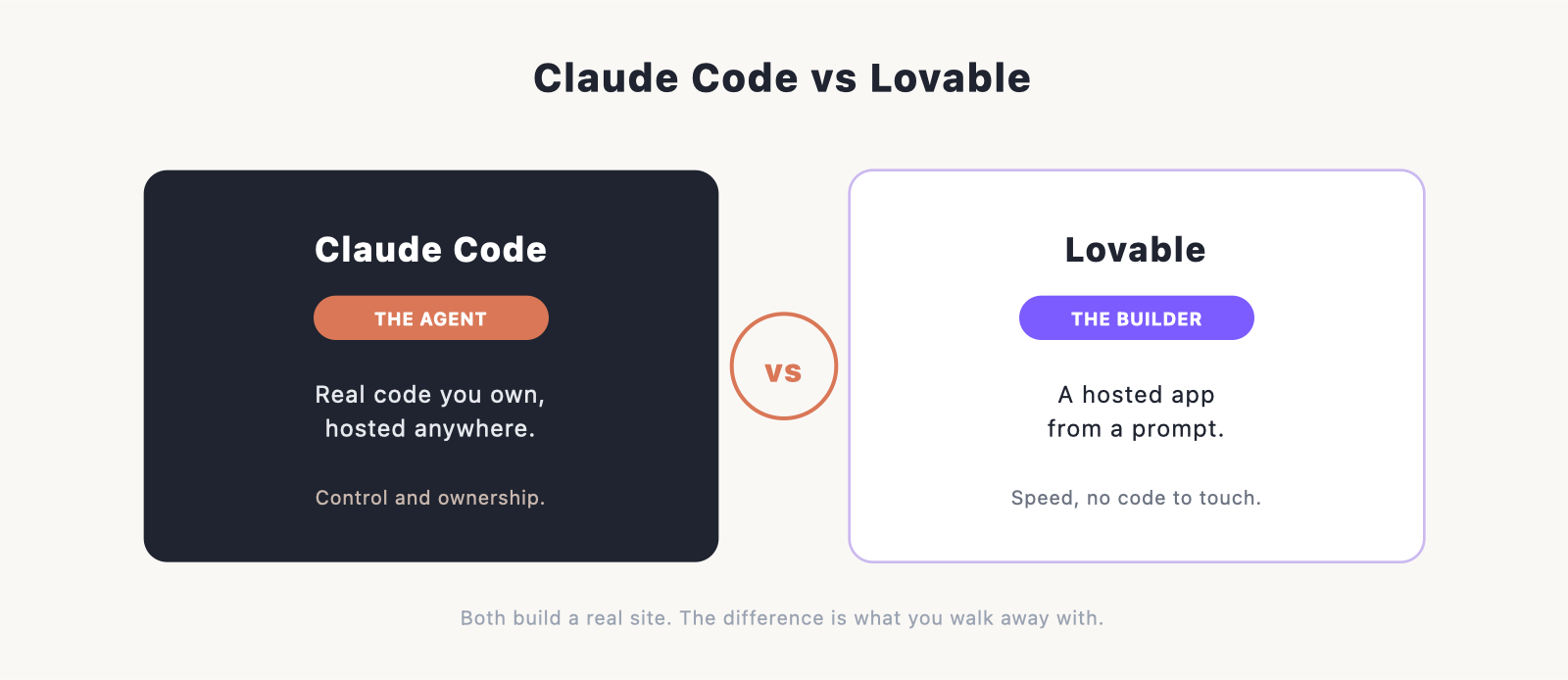
Claude Code and Lovable both use AI to build a website, but they come at it from opposite directions. Lovable turns a description into a working, hosted app in minutes, with no code for you to touch. Claude Code is an agent that writes real code in a project you own and can take anywhere. This guide explains the trade-off in plain terms and helps you pick.
New to either? Our main Claude Code guide and our walkthrough on building a website with Lovable cover each on its own. Come here when you’re choosing between the two.
The short answer
If you want a working app as fast as possible and you’re happy for it to live on a platform, Lovable is hard to beat. If you want to own the code outright, avoid lock-in, and keep full control of where your site runs, Claude Code is the better fit, and its desktop app keeps that approachable. Both can get a non-coder to a live site; they differ in what you walk away with.
What each one is
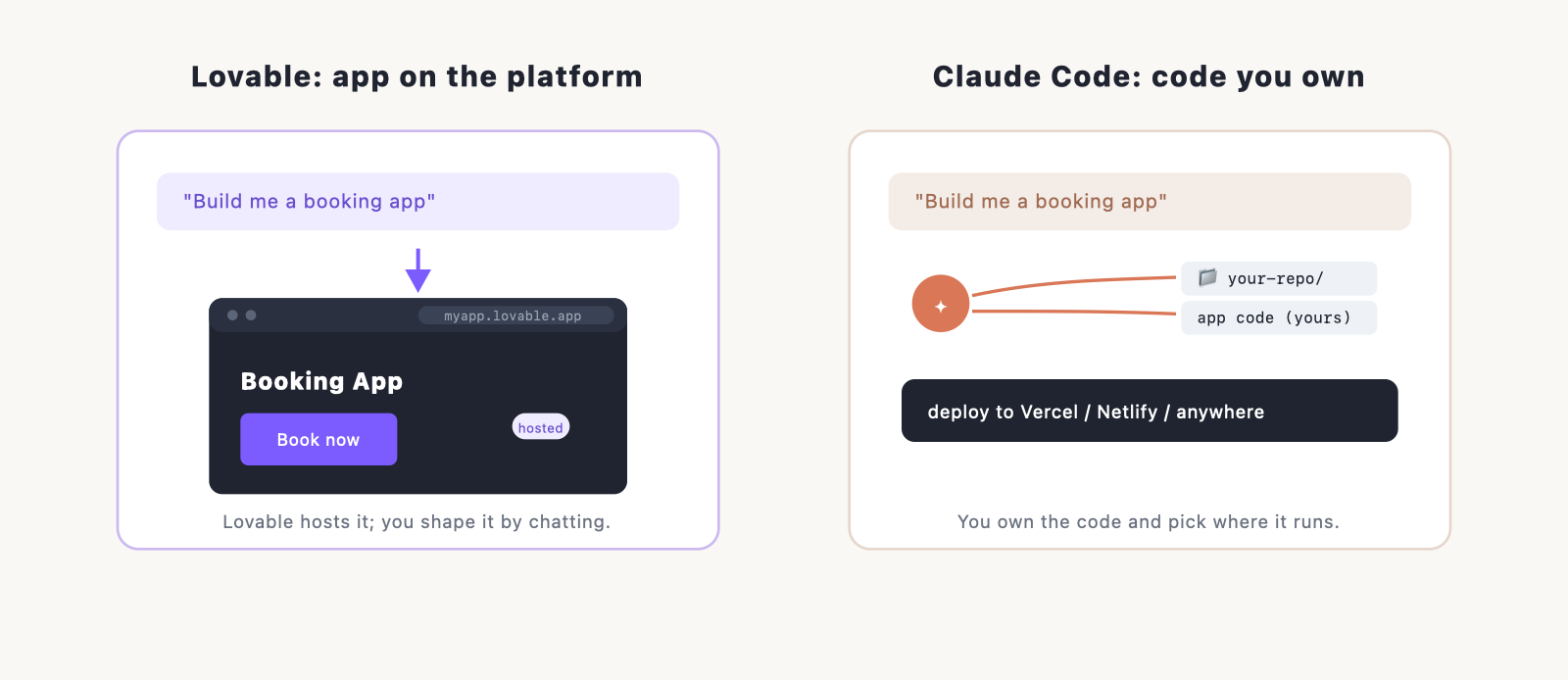
Lovable is a prompt-to-app builder. You describe the site or app you want in a chat box, and Lovable generates a complete, working version, frontend and backend, running live in your browser. It handles the hosting, can wire up a database for you, and you shape it by chatting rather than editing code. It’s built for speed: idea to working app in one sitting.
Claude Code is an AI coding agent. You describe what you want and it writes real code into a project on your own machine or repo: standard files, in whatever framework you like, that you fully own. It can run commands, fix its own errors, and you deploy the result wherever you choose. It runs as a friendly desktop app, in the browser, the terminal, or an editor.
The core difference: Lovable hands you a finished app that lives on its platform. Claude Code hands you the codebase itself, to keep and host anywhere.
How they compare
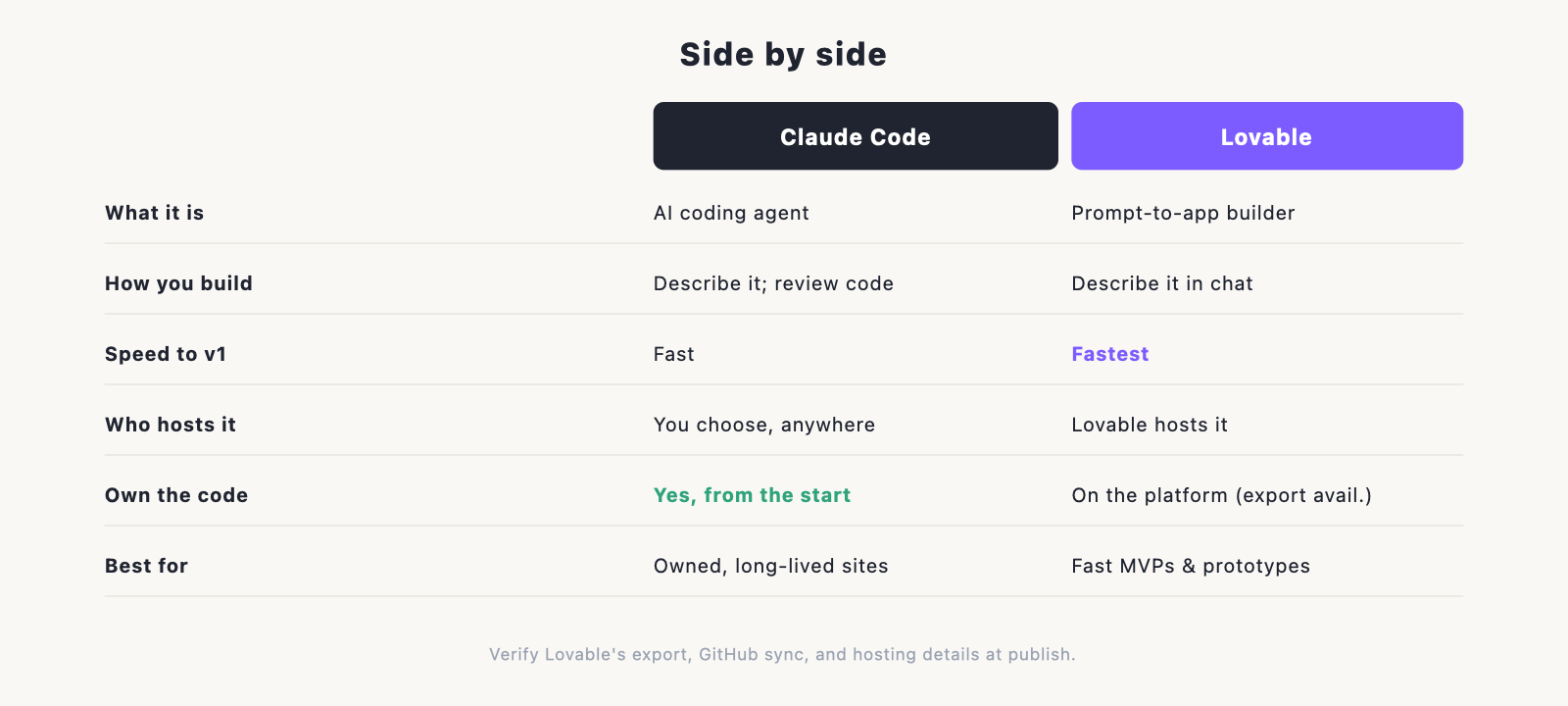
Both are good, and both can build a real, useful site. They differ most in ownership, control, and how fast you get there.
| Claude Code | Lovable | |
|---|---|---|
| What it is | An AI coding agent | A prompt-to-app builder |
| How you build | Describe it; review real code | Describe it in chat |
| Speed to first version | Fast | Fastest |
| Who hosts it | You choose (Vercel, Netlify, anywhere) | Lovable hosts it for you |
| Do you own the code | Yes, fully, from the start | The app lives on the platform (export/GitHub sync available) |
| Lock-in | None | Some; you build around the platform |
| Learning curve | Low with the app | Lowest |
| Best for | Owned, custom, long-lived sites | Fast MVPs and prototypes |
Which should you choose?
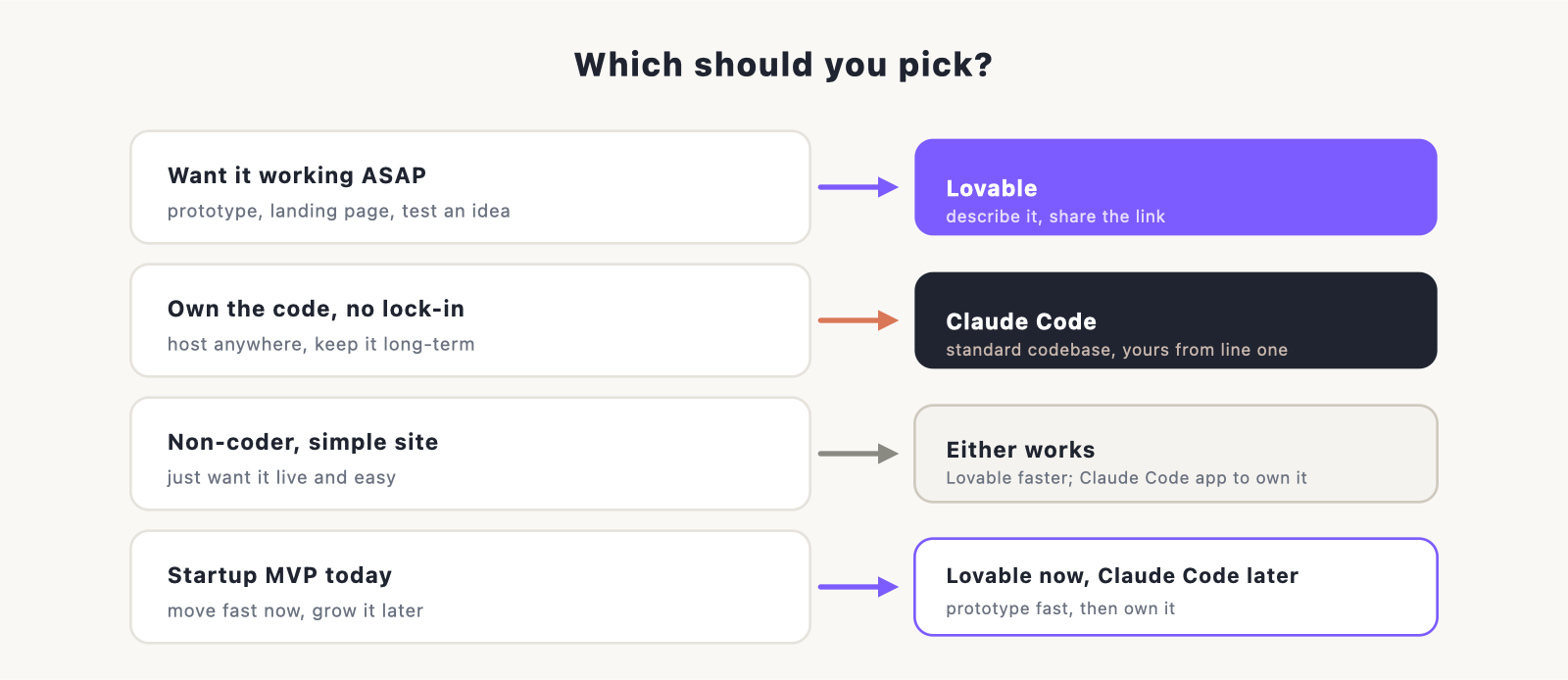
Less about which is “better,” more about what you want to end up with.
You want something working as fast as humanly possible. Lovable. Describe it, watch it appear, share the link. For a quick prototype, a landing page, or testing an idea this week, it’s the shortest path.
You want to own the code and avoid lock-in. Claude Code. You get a standard codebase from the first prompt, host it anywhere, and you’re never tied to one platform’s pricing or roadmap.
You’re a non-coder building a fairly simple site. Either works. Lovable is faster and never shows you code; Claude Code’s desktop app is nearly as easy and leaves you owning the result. If you’d rather not think about code or hosting at all, also look at other AI website builders.
You’re building a startup MVP. Lovable to get something in front of users this week. If it takes off and you need full control of a long-lived product, Claude Code is the better home, and you can move toward it later.
The part that really matters: owning your code
This is the heart of the choice. With Lovable, the app lives on Lovable’s platform. That’s exactly why it’s so fast, since the platform handles the hard parts, but it also means you’re building inside someone else’s system. Lovable does offer ways out, like syncing to GitHub, so it’s not a locked box, but the natural home of the project is the platform.
With Claude Code, the code is yours from the first line. It sits in your folder and your Git repo, in a standard format any developer can pick up, and you deploy it wherever you like. If independence and longevity matter to you, that’s the deciding factor. If speed matters more right now, it may not.
Pricing
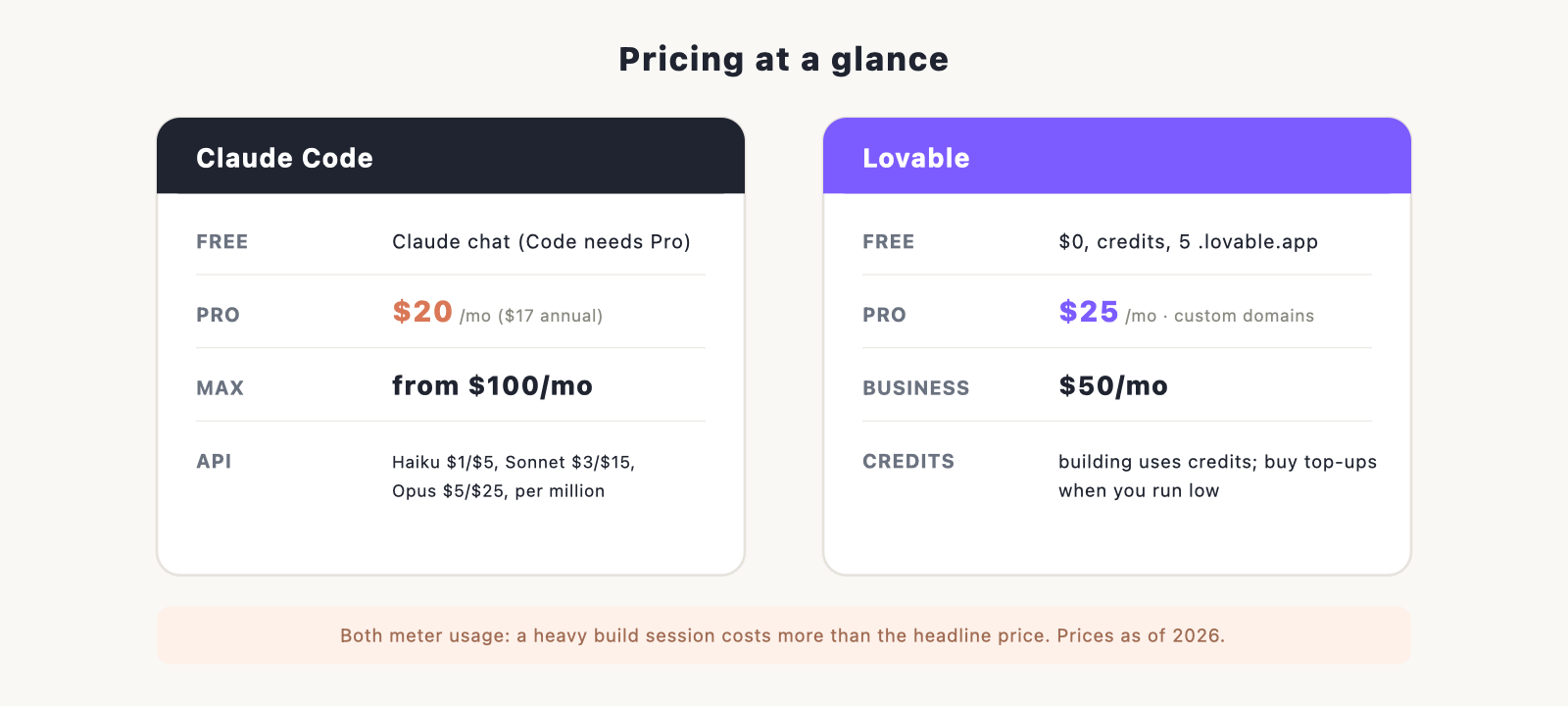
Both have a free tier, and with both, heavier use costs more. (Prices as of 2026; check current pages.)
- Claude Code comes with Claude Pro at $20 a month ($17 billed annually), with Max from $100 a month for heavy use, or pay-as-you-go via the API. Pro’s token allowance is fairly tight, Max is much more generous (though even Max can run out in long sessions), and going past your limits or using the API is metered per token and climbs fast. Models set the rate: Haiku about $1/$5, Sonnet $3/$15, Opus $5/$25 per million tokens.
- Lovable is free to start (with credit grants and a few lovable.app domains), then Pro at $25 a month and Business at $50 a month. It runs on credits: building and changing your app consumes them, and you can buy top-ups when you run low. As with Claude Code, the more you build, the more it costs.
The shared lesson: both meter usage, so an afternoon of heavy iterating can cost more than the headline price. For a wider cost comparison, see our how much does a website cost guide.
Can you use both?
Yes, and it’s a smart workflow. Many people prototype fast in Lovable to prove an idea, then rebuild or extend it with Claude Code when they want to own the code and take it further. Lovable for speed early on, Claude Code for control later. There’s no rule that you pick one forever.
Verdict
For pure speed to a working, hosted app, Lovable wins, and it’s a joy for prototypes and simple sites. For owning your code, avoiding lock-in, and building something you’ll keep and grow, Claude Code is the stronger choice, and its desktop app means you don’t need to be a developer to start. Many people use Lovable to move fast, then Claude Code to make it lasting.
Ready to try the agent route? Our main Claude Code guide walks through building and launching a site, and the install guide gets you set up in about ten minutes. Curious about the builder route first? See building a website with Lovable.
Frequently asked questions
Is Claude Code or Lovable better for beginners? Both are beginner-friendly. Lovable is the fastest and never shows you code. Claude Code’s desktop app is nearly as easy and leaves you owning the code.
Do I own my code with Lovable? The app lives on Lovable’s platform, which is what makes it so fast. Lovable offers ways out, like GitHub sync, but the project’s natural home is the platform. With Claude Code, the code is yours from the start.
Which is cheaper? Their paid plans are close (Lovable Pro $25/mo, Claude Pro $20/mo), but both meter usage, so real cost depends on how much you build. Lovable runs on credits; Claude Code on plan limits or per-token API. Check current pricing.
Can Lovable build a backend? Yes. Lovable can set up a database and backend for you as part of the app, which is a big part of its appeal. With Claude Code you can build the same thing, with more control over how.
Should I prototype in Lovable and switch to Claude Code? That’s a common and sensible path: move fast in Lovable to validate the idea, then bring in Claude Code when you want to own and grow the code.