Finding good website name ideas is crucial. After all, your website is the first thing your visitors see, and it represents your brand and identity online. As such, it’s important to choose the right domain name.
Another reason why it’s essential to choose cool website names is that changing your website domain later can be a hassle – it affects your SEO, your brand recognition, and every piece of marketing material you’ve ever created.
However, finding good website name ideas that haven’t been taken is not as easy as it seems. By now, most cool website names have already been registered. This isn’t surprising given that websites have been around since the 1990s, and as of Q4 2025, there were 386.9 million domain name registrations across all top-level domains (TLDs).
But that doesn’t mean all is lost, and you should give up. There are still plenty of ways to come up with a cool website name.
Ready? Let’s start.
What Makes a Great Website Name?
Before you start brainstorming, it helps to understand what separates a forgettable website name from one that sticks. A great website name should check these five boxes:
- Brandable. It sounds like a real brand, not just a string of keywords. Think Amazon.com, not BuyBooksOnline.com. A brandable name creates a distinct identity that people associate with your business.
- Memorable and easy to share. Apply the “radio test” – if you told someone your website name in a noisy room, could they find it later? If you have to spell it out every time, it’s probably not the right name. Avoid hyphens, numbers, and unusual spellings.
- Relevant. The name should hint at what you do or connect with your target audience. Fitbit immediately suggests fitness. ThriveMarket resonates with people who value healthy living.
- Available. This is the practical deal-breaker. Is the domain available? Are the social media handles free? Is it legally distinct from existing trademarks?
- Enduring. Will the name still make sense in five or ten years? Avoid trendy slang or overly specific names that could limit your brand as it grows.
Keep these principles in mind as you work through the tips and strategies below. They’ll help you evaluate every idea that comes up during your brainstorming sessions.
Finding Cool Website Name Ideas and Business Name Ideas Go Hand in Hand
Although it’s getting harder to find cool website names, it’s not mission impossible. Here are a few tips and tools that will help you find a creative name for your website.
- Do your research. Search for your chosen website name and see if it’s been registered. Simply enter your desired website name into Google and see what pops up. If you’re lucky, you’ll get no results and will be able to register the domain right away.
- Consider local TLDs. If you’re doing business locally or if your target audience is local, consider using a top-level domain (TLD) for your regions, such as .us or .ca.
- Consider non-traditional TLDs. The .com is the most common and well-known domain extension, but you’re not limited to it. There are hundreds of newer domain extensions that can work well for unique website names. Try .me for a personal website or experiment with .store, .design, .site, or .biz for a more modern option. .ai domains have become especially popular – by late 2025, there were over 908,000 registered .ai domains worldwide.
- Keep long-term branding opportunities in mind. It’s no secret that some website names have become part of our everyday culture. Google, Xerox, and Chapstick are just a few examples of brand names that have become part of our language.
- Name your business at the same time. If you’re just getting started and don’t yet have a created a website, brand identity, or other business, figuring out your online business name and your website name simultaneously is beneficial. You won’t have to worry about fitting a square peg into a round hole – you can name your eCommerce business or startup to be inherently domain name-friendly.
Website Name Tips
Here are some practical tips on how to choose a website name:
- If possible, stick with a .com domain name since it’s the most popular and well-known domain extension. Alternatively, you can use local domain extensions, like .ca or .us, or non-traditional extensions, such as .biz or .io. Note that .com domains typically cost between $10-20 per year as of 2026.
- Avoid using hyphens and numbers in domain names – they’re hard to communicate verbally and look unprofessional.
- Make your website name memorable.
- Make it easy to spell and pronounce.
- Avoid double letters, as this can make your website name harder to spell and remember.
- Keep it short – aim for 2-3 words. Shorter names are easier to type, remember, and fit on business cards and social media profiles.
- Don’t be too specific. Consider what happens if you decide to change direction or want to expand later on.
- Use a Thesaurus to come up with synonyms if your original idea is taken.
- Brainstorm related words that you can use together with your original idea.
- Use an online translator to see how your word sounds and looks in a different language (for example, flower/flor).
- Add an adjective or another word to the original name.
- Write your website name down to see how it looks with no spacing. This will ensure you don’t end up with an embarrassing name (for example, “Pen Island” becomes “penisland”).
- Use a website name generator to come up with ideas.
21 Creative Strategies for Brainstorming Website Names
If the tips above haven’t sparked the perfect name yet, try these specific brainstorming techniques. Each one includes a formula and example so you can apply it to any niche.
1. Add a Place or Destination to Your Keyword
Take your niche keyword and pair it with a tangible location. This gives your website a sense of place.
Formula: niche + place
Examples: CookingPalace.com, DesignStudio.com, FitnessIsland.com
2. Use a Personal Pronoun
Adding a personal pronoun like “Your,” “My,” or “Our” makes the name feel tailored to each visitor.
Formula: pronoun + niche
Examples: YourStyleGuide.com, MyCodeLab.com, OurKitchenTable.com
This is also a handy trick if your preferred name is taken – try adding “Your” or “My” in front of it.
3. Add an Emotive Word
Humans are driven by emotions. An emotive word adds personality and connection.
Formula: emotive word + niche
Examples: ThePassionatePhotographer.com, BoldBaking.com, JoyfulGardening.com
4. Create a Portmanteau
A portmanteau blends two words into one new word. Pinterest (pin + interest) and Groupon (group + coupon) are famous examples.
Formula: word 1 + word 2 = blended word
Examples: Beautiscara (beauty + mascara), Techsplore (tech + explore), Fitspire (fitness + inspire)
5. Use Adjectives and Descriptive Words
Simple adjectives like “smart,” “easy,” “real,” or “super” can transform a taken domain name into an available one.
Formula: adjective + niche
Examples: SmartFinance.com, EasyRecipes.com, RealTechReviews.com
6. Add an Authority Word
Words like “wizard,” “guru,” “captain,” or “professor” add a sense of expertise.
Formula: authority word + niche
Examples: BloggingWizard.com, CaptainCode.com, DesignProfessor.com
7. Describe Your Website Type
What type of content will your site offer? Use words like “hub,” “journal,” “lab,” “studio,” or “daily” to describe it.
Formula: niche + type
Examples: TheDesignJournal.com, FitnessLab.com, DailyTechBrief.com
8. Add a Transformation Verb
If your website helps people improve or change, transformation verbs like “thrive,” “boost,” “renew,” or “elevate” work well.
Formula: verb + niche
Examples: ThriveWellness.com, BoostYourBusiness.com, ElevateDesign.com
9. Use an Inspirational or Motivational Word
Words like “ambition,” “believe,” “courage,” or “hopeful” can make your website feel uplifting before someone even clicks.
Formula: inspirational word + niche
Examples: CourageousLiving.com, BelieveInFitness.com, AmbitiousCreatives.com
10. Pair Your Niche With an Animal
Animals add personality and can inspire your logo and branding. This works best for websites that don’t take themselves too seriously.
Formula: niche + animal
Examples: CodeMonkey.com, DesignFox.com, OfficeMonster.com
11. Include Your Location
If your business serves a specific area, adding a location helps visitors understand where to find you and can help with local SEO.
Formula: niche + location
Examples: TechAustin.com, LondonBakery.com, NYCYoga.com
Note: Location-specific names may limit your audience if you decide to expand later.
12. Use a Thesaurus
If your ideal name is taken, a thesaurus can help you find a synonym that works just as well.
Example: “Total Fitness” is taken? Try Absolute Fitness, Complete Fitness, or Sheer Fitness.
13. Add a Community Word
Words like “family,” “tribe,” “league,” “collective,” or “crew” signal that your website is a community.
Formula: community word + niche
Examples: TheDesignCollective.com, FitnessFamily.com, CreativeCrew.com
14. Search for Related Words
Tools like RelatedWords.org can help you find words connected to your niche without using the obvious keyword.
Example: Searching “technology” might return words like “gadget,” “circuit,” “chip,” and “cipher” – any of which could form the basis of a unique name.
15. Use a Related Phrase Instead of a Keyword
Think of phrases or sayings associated with your niche. This gives your website more room to grow into related topics.
Examples: “Captain of the Seas” for a fishing blog, “The Last Bite” for a food blog, “The Open Road” for a travel blog.
16. Get Inspired by Competitors
Look at how competitors in your niche construct their domain names. Use the same structural approach but with your own words.
Example: If a competitor uses “TackleBox.com,” try “BaitCrate.com” (thesaurus swap) or “TackleTrout.com” (alliteration).
17. Try a Domain Name Formula
Create your own formula based on your keyword and your audience’s goal.
Formulas:
- niche + goal = LittleFitnessHabits.com
- niche + timeframe = 30MinuteMeals.com
- niche + audience = CodingForBeginners.com
18. Use Your Own Name
If you’re building a personal brand – as a freelancer, consultant, coach, or creator – using your own name is a timeless choice.
Example: JaneSmith.com, JohnDoeDesign.com
The upside is flexibility if you ever change direction. The downside is that it doesn’t immediately communicate what you do, and it’s harder to sell the brand later.
19. Use Alliteration
Repeating the same starting sound makes a name catchy and memorable.
Examples: Blogging Wizard, Dunkin’ Donuts, PayPal, Coca-Cola, Fun Fit Families, Babbling Babies
20. Use an Online Translator
Foreign words can add elegance and uniqueness. Check how your keyword sounds in languages like Spanish, Italian, French, or Japanese.
Example: “Flower” becomes “Flor” (Spanish), “Fiore” (Italian), or “Hana” (Japanese).
21. Blend Multiple Strategies Together
If one strategy isn’t enough, combine two or three.
Examples:
- Pronoun + emotive word + niche = YourBoldKitchen.com
- Alliteration + authority word = Captain Creative Co.
- Location + adjective + niche = LondonLeanFitness.com
Website Name Ideas by Category
Need a spark of inspiration? Here are website name ideas organized by style and niche. Use these as starting points – combine words, swap synonyms, and make them your own.
Catchy and Creative Names
- Pixel Pulpit
- The Idea Weave
- Momentum Mills
- Echo & Ember
- The Spark Syndicate
- Fable & Frame
- The Concept Forge
- Logic & Loom
- Clever Clover
- Neon Nexus
Professional and Business Names
- Keystone Strategy
- Summit Solutions
- The Clarity Co.
- Blue Ocean Strategies
- TrueNorth Advisors
- The Fulcrum Firm
- Apex Partners
- The Meridian Group
- GrowthArc Consulting
- The Method Makers
Blog and Personal Brand Names
- The Curated Life
- Midnight Musings
- Purpose & Poise
- The Clarity Chronicle
- The Everyday Epic
- The Deliberate Day
- The Unwritten
- The Authentic Angle
- The Growth Guild
- Your Next Chapter
Ecommerce and Online Store Names
- The Artisan Cart
- Urban Trove
- Gilded Goods
- Poppy & Pine
- Thread & Thistle
- The Modern Market
- The Curated Crate
- The Essential Edit
- The Heritage Post
- The Value Vault
Tech and SaaS Names
- CodeSphere
- BrightByte
- LogicLoop
- CloudCanvas
- NextGrid
- DataWeave
- SecureStack
- The Code Key
- Cipher Cloud
- Pivot Path
Food and Recipe Blog Names
- The Gilded Fork
- Crumb & Kettle
- Salt & Sage
- The Toasted Table
- The Wholesome Spoon
- Basil & Butter
- The Simmering Pot
- The Humble Crumb
- The Weekend Whisk
- The Seasoned Story
Use a Website Name Idea Generator
As we mentioned above, a website name generator is a great way to come up with cool website names. These tools come in handy if you’ve exhausted all the brainstorming strategies and can’t find a name you like.
But what is a website name generator?
Put simply, a website name generator is an online tool that helps you come up with a unique name for your website. It generates website names and typically links to a popular domain name registrar so you can immediately register your chosen domain name.
How Website Name Generators Work
Website name generators work in different ways. Some of them will ask you to enter a few keywords that best describe your website’s purpose or topic. Then, they’ll simply mash your keywords together to come up with unique, unusual, and often cool website names.
Other website name generators use an API combined with custom rules and exclusions to generate website name ideas that you can use.
Finally, some generators use a complex algorithm or natural language processing to provide variations in the spelling, dropping letters, merging vowels, mixing syllables, and swapping related words to come up with a unique website name. Modern generators increasingly use AI and machine learning to create more sophisticated and brandable name suggestions.
In the end, you’ll end up with results for website name ideas that have unusual spelling or are made up of non-existent words that sound real and could present a perfect branding opportunity for your business website.
A word of caution: Use generators for inspiration, not as the final answer. Their best suggestions are often already taken, but they can show you word combinations you hadn’t considered. Treat them as one tool in your brainstorming toolkit, not the whole toolkit.
Best Website Name Generators
There are plenty of domain name generators out there, but not all of them are created equal.
Below, you’ll find a list of the most popular website name generators and a brief description of their features so you can decide which one you want to use to create your cool website names.
1. DomainWheel
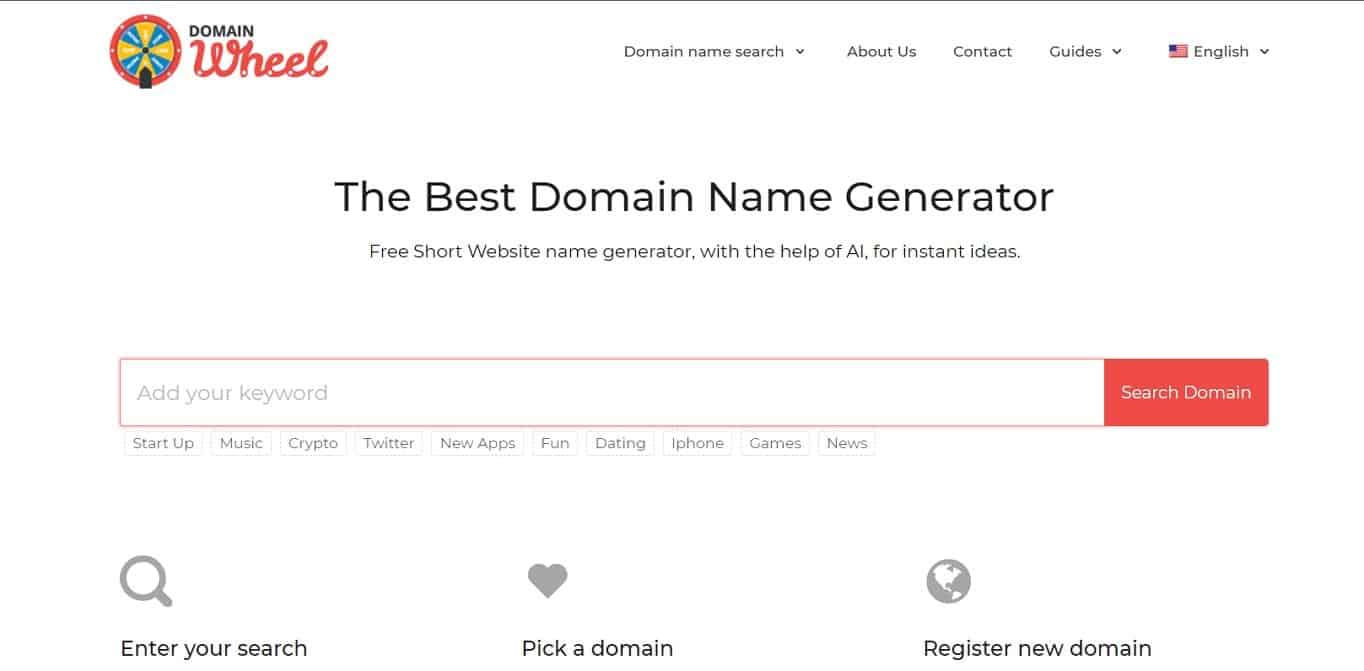
DomainWheel, the first tool on our list, uses AI to generate website name ideas based on your keywords. You can also select the desired extensions from the dropdown and then click search.
Clicking the View Details button takes you straight to Bluehost, where you can use a website name checker to check website name availability. You can then sign up for a web hosting plan and get a free domain name.
If you come across unavailable domains, it’s back to the drawing board – but often, there will be secondary custom domain choices that’ll work fine, too.
2. Nameboy
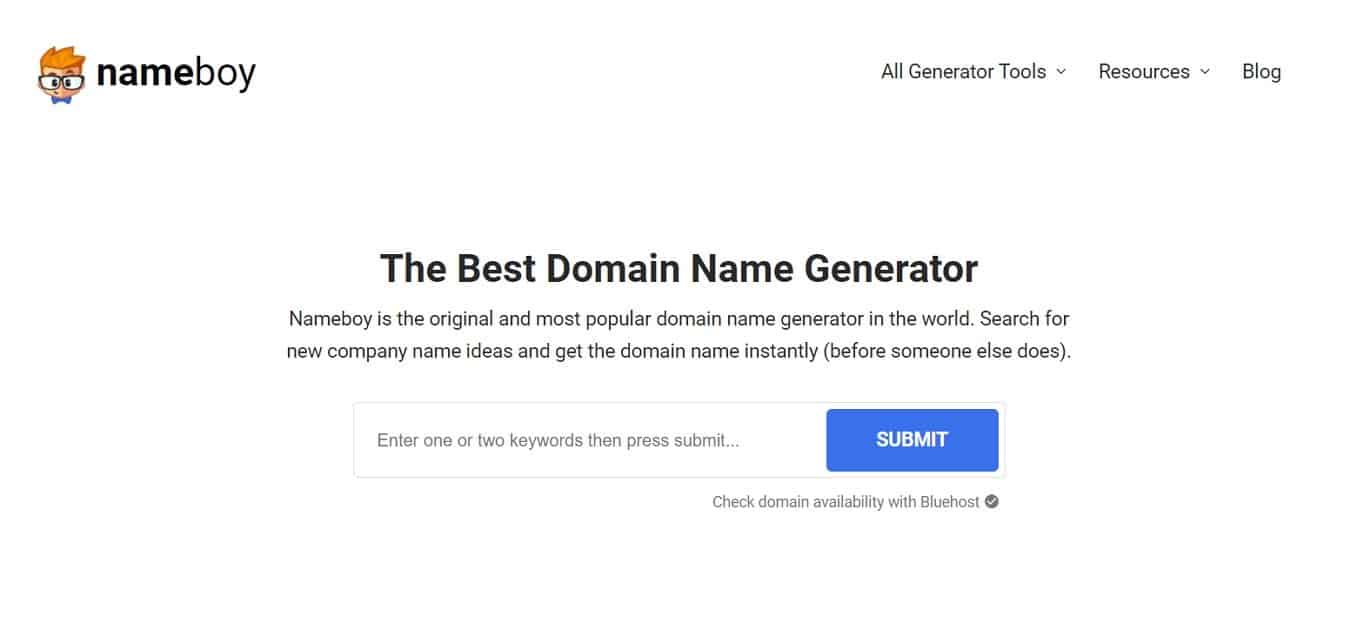
To use Nameboy‘s website name generator, you’ll need to enter one or two keywords, and press submit. Nameboy uses an AI algorithm that combines common words, prefixes, random words, suffixes, and keywords to generate ideas.
With Nameboy’s domain search tool, you can immediately verify domain availability and register it with Bluehost. And it even has helpful tips on choosing the best cool website names.
Additionally, Nameboy offers business, YouTube, eCommerce, blog, and other name generators.
3. Lean Domain Search
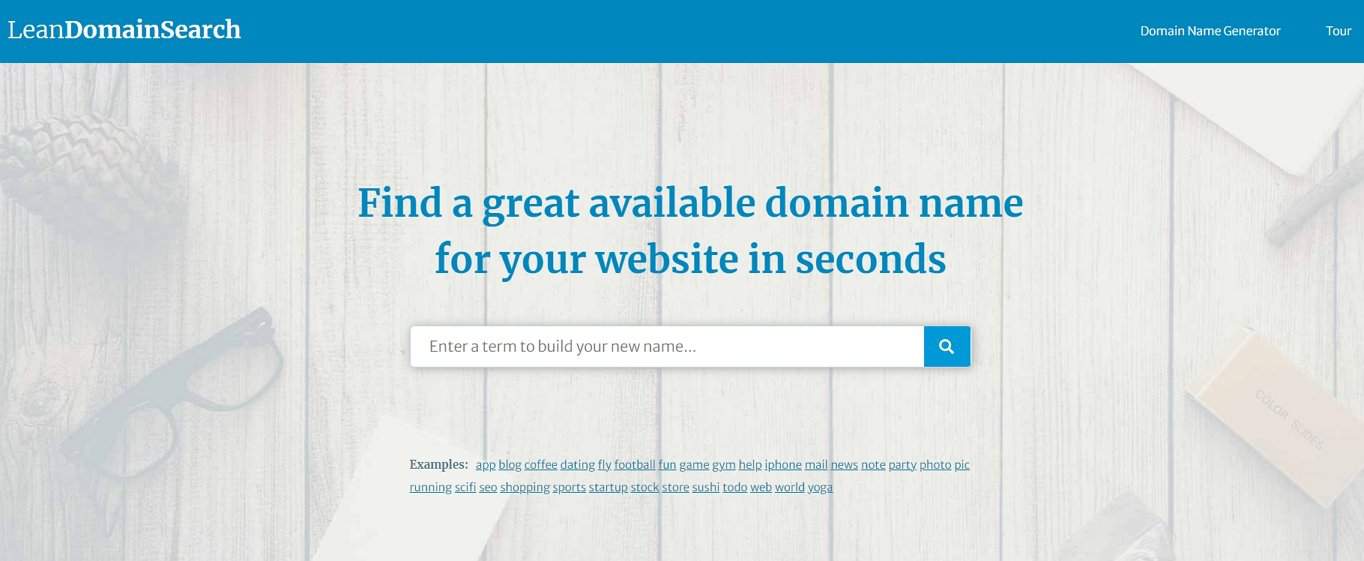
Lean Domain Search has a simple interface prompting you to enter a keyword and start searching for your website name ideas.
Lean Domain Search was built by Automattic, the parent company behind WordPress. It pairs your keyword with other keywords commonly found in domain names and uses them to generate website names.
Once you click on your chosen domain name, the tool will tell you if the name is available with a .com domain extension and as a Twitter username. You can then register the name and create your website with WordPress.com or register your domain name ideas with Bluehost.
4. Panabee
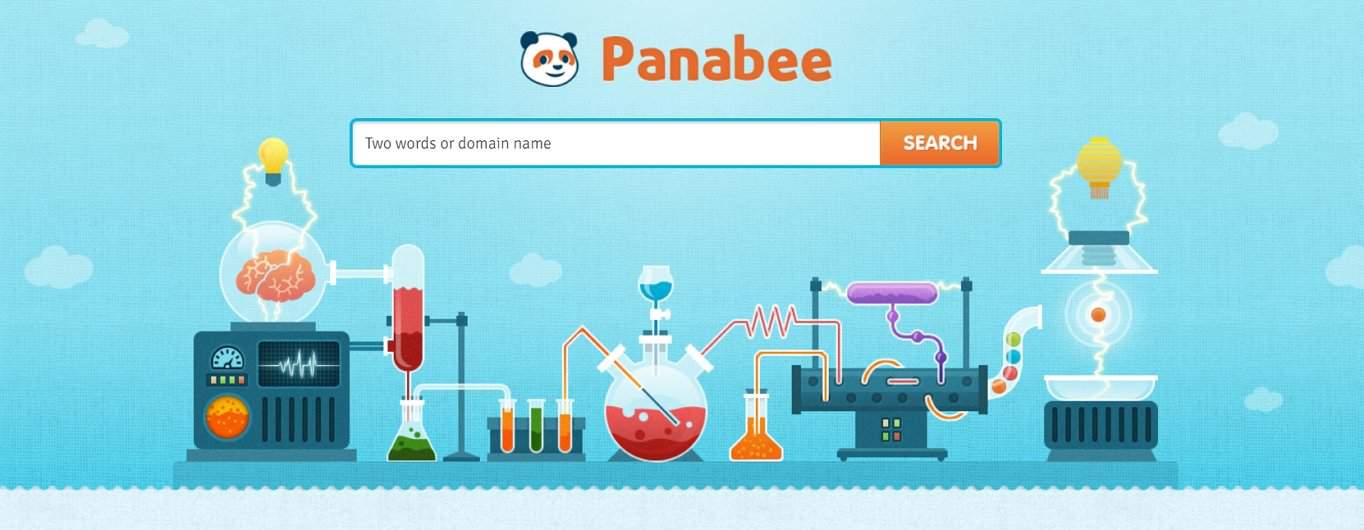
With Panabee, you’ll need to enter two keywords or a domain name and then press Search to let the tool work its magic. This tool will search the .com extensions by default, but you can explore other domain extensions as well.
Panabee comes up with suggestions by using phonemes, syllables, abbreviations, suffixes, prefixes, and popular domain trends. You can also check if the cool website names it generates are available on Twitter, Facebook, and Instagram.
Once you find a name you like, the tool will redirect you to a domain registrar to register it (the registrar can vary by location, such as IONOS or others).
5. Namelix
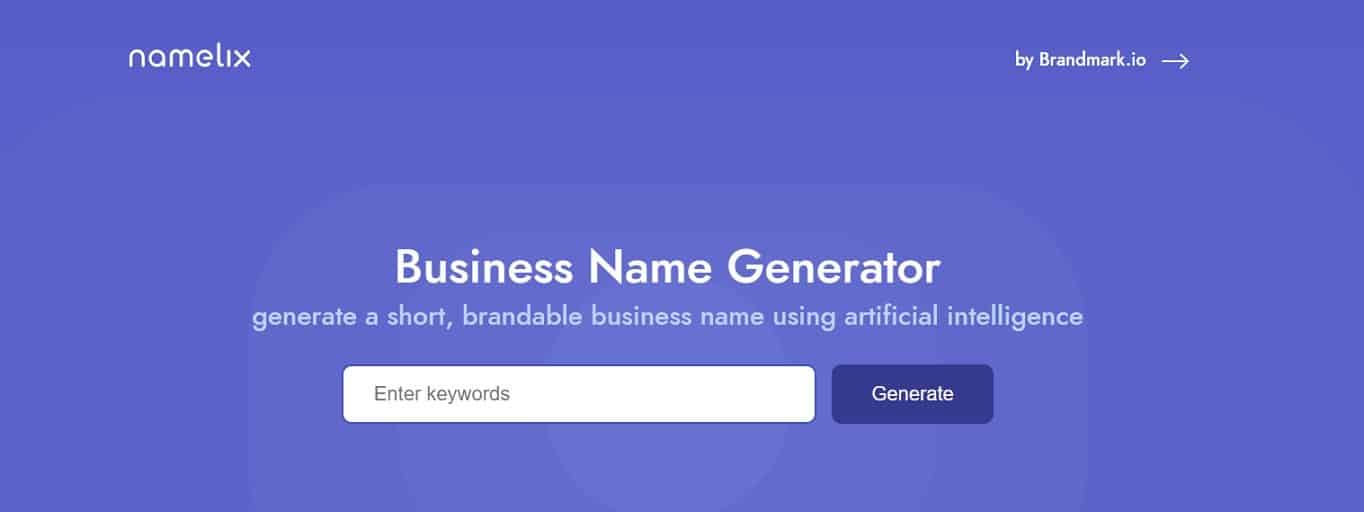
Namelix is another tool on this list that uses AI to come up with unique website name ideas. The more keywords you enter, the better your results will be. It’s technically a small business name generator, but if it works for coming up with company names, it’ll work well for other purposes, too.
With Namelix, you can filter your results to include a specific keyword or an extension. Another useful feature is that you can save domain names so you can get better suggestions next time. You can also specify whether you want to find brandable domain names, misspellings, or foreign words.
Namelix stands out from other tools on this list because it also lets you see logo ideas for the website names you’ve generated. Once you find a name you like, you can register it with Namecheap.
6. Shopify Domain Name Generator
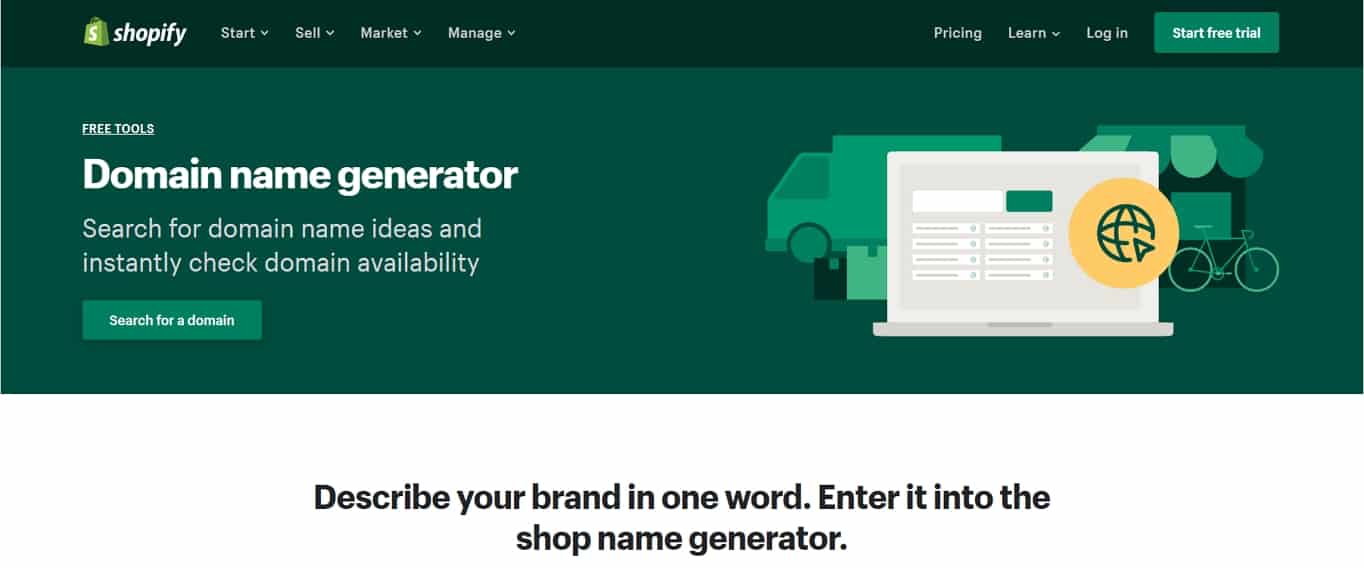
Shopify Domain Name Generator empowers you to search for potential website name ideas and see if they’re available for domain registration.
Shopify’s tool uses your keywords and pairs them with multiple different domain name extensions. It will also suggest alternative ideas using slightly modified, related keywords.
Unlike other tools on this list, Shopify will prompt you to sign up for its platform once you find a name you like and want to register it. However, you don’t have to use Shopify beyond coming up with a domain name.
7. Namify
Namify is an AI-powered website name generator that combines branding expertise with machine learning to instantly generate unique and memorable names. Namify offers contextual and meaningful name suggestions crafted to ensure your website stands out in the digital realm.
The tool provides social media username availability checking and offers free logo creation for your brand to match your purchased domain name. With 85+ categories and the ability to filter by specific terms and tags, Namify provides highly customized results for your branding needs.
How To Find a Website Name Using Website Name Generators
Now that you know what a website name generator is and how it works, the only thing left to do is use one to come up with a cool website name idea.
While the easiest method is to pick a website name generator and let it work its magic, we’re going to advise you against doing that.
Instead, experiment with different name generators to come up with more cool website names. Keep in mind that some of the generated website name ideas won’t be usable at all.
If you’re using only one generator, you may walk away with no results and think it was a complete waste of time.
But, if you use multiple website name generators, you’ll get more results – and more importantly, more website name ideas that work.
Here’s a step-by-step process that combines manual brainstorming with generators for the best results:
- Start with keywords. Create a list of 20-30 keywords that describe your website’s purpose, niche, audience, and the feelings you want to evoke.
- Try the brainstorming strategies first. Work through the 21 strategies above using your keywords. Write down every idea, even the ones that seem silly.
- Run your keywords through multiple generators. Visit at least 3-4 of the generators listed above and enter your keywords. Save any results that catch your eye.
- Check domain availability. Use a domain registrar to verify your top picks are available as .com domains (or your preferred extension).
- Check social media availability. This ensures you maintain brand consistency and work on establishing brand recognition across all platforms.
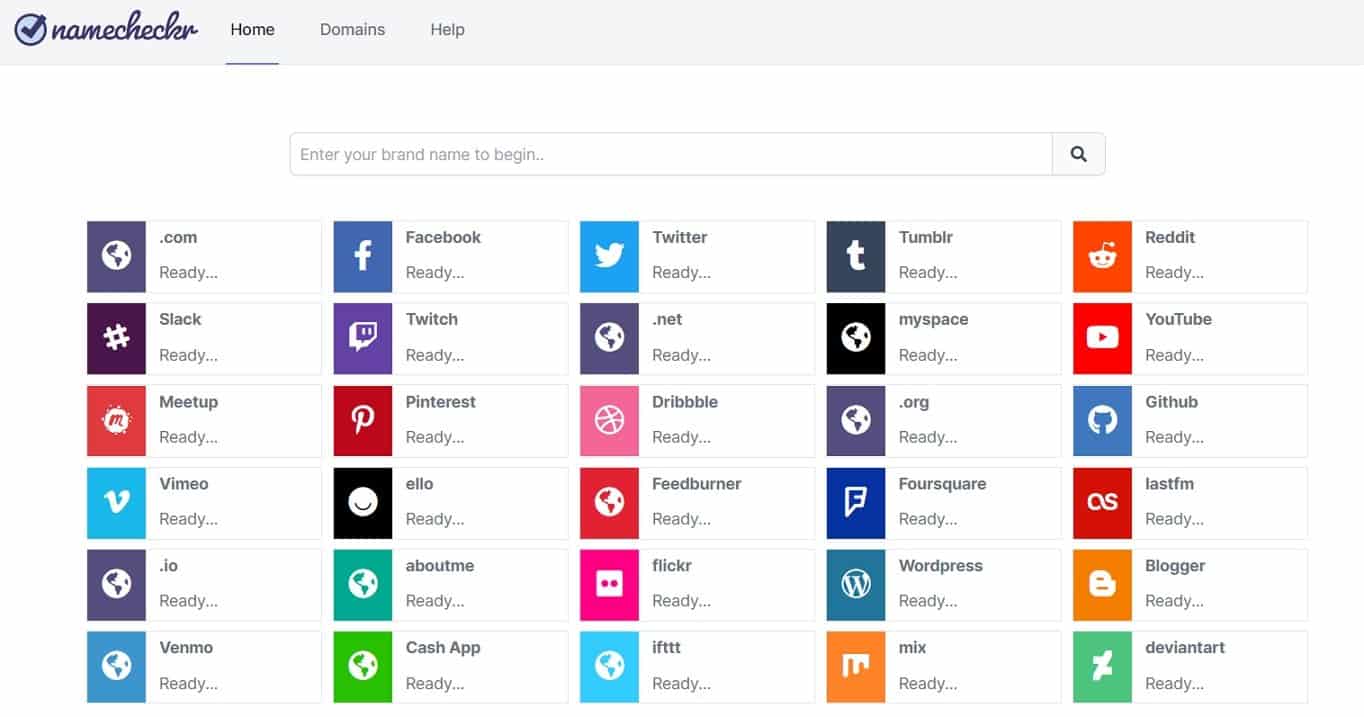
You can use a few helpful tools to check whether your chosen name is available on social media, including Namechk, KnowEm and BrandSnag. These tools will check your name with various domain name extensions and all major social media platforms and let you know if the name has been taken.
It’s also a good idea to run a trademark search on your chosen website name to ensure it’s free of any trademarks or copyright issues and clear to use.
You can use your local trademark database to perform the search. For example, in the U.S., you can search the United States Patent and Trademark Office for live trademarks. The USPTO updated their trademark search system in 2024 with new search builder features to make the process more user-friendly.
Do Your Research Before Buying
Before buying a domain, do some research. Search for website name ideas via search engines and use the Wayback Machine to check out its history.
You won’t find every website this way, but if the domain ever received considerable traffic in the past, you should be able to see that, and if anything unsavory was once associated with it.
If you find results that point to questionable content, you may want to go back to the drawing board if the results are recent in history. However, if the results date back significantly and there is nothing unsavory in recent years, the final decision is up to you and how you feel about it.
Don’t forget to take into account the amount of traffic the website once received, too. Again, if you feel uncomfortable with the results, it’s better to start the search for cool website names than to wind up with a domain that will paint a bad picture of you or your business.
Register Your Domain Name Quickly
Once you find website name ideas you like, don’t sit on them for too long. It’s important to act quickly, so someone else doesn’t register your chosen name before you. Register the domain name as soon as possible to prevent that from happening.
Another thing you may want to consider is registering variations of your chosen name using other domain extensions, such as .net or .co. Doing so will prevent someone else from posing as you and potentially damaging your brand reputation.
Purchase common misspellings as well, so your visitors don’t end up on someone else’s website, a parked domain, or on a blank browser page with a warning that no such website exists.
You can always redirect other domains to your primary domain using a 301 permanent redirect. That way, if someone types them in by mistake, they’ll still end up on your website.
Important note about domain pricing in 2026: .com domain prices have increased significantly, with Verisign implementing consecutive 7% price increases from 2021-2024, resulting in a 30% total price increase. As of 2026, .com domains typically cost between $10-20 per year, with renewal rates often higher than initial registration rates.
Get a Free Domain With Hosting
As we mentioned above, register domains for your website name ideas as quickly as possible once you’ve found a cool name for your website. However, it’s worth noting you can get a free domain when you sign up for a hosting plan in some cases.
Hosting companies like Bluehost offer a free domain when you buy a year or more of hosting. The domain name is free for the first year, and after that, it will renew at its regular rate, which is typically around $12-18 for a .com extension as of 2026.
Keep in mind that domain prices vary by extension. New generic TLDs (ngTLDs) like .shop, .tech, and .online have seen significant growth, with a 17.4% year-over-year increase in registrations. Meanwhile, .shop surged in popularity at Namecheap in 2024, ranking as the second-most-registered TLD after .com and ending the year with 721,532 registrations.
Frequently Asked Questions
What’s the difference between a website name and a domain name?
In most cases, “website name” and “domain name” are used interchangeably. Technically, a website name is the branded or common name people use to refer to your site (like “WebsiteSetup”), while a domain name is the actual web address (like websitesetup.org). For practical purposes, they mean the same thing – it’s the name people type into their browser to find you.
Should I always try to get a .com domain?
A .com domain is still the gold standard because it’s what most people type by default and it carries the most trust. However, if your ideal .com is taken, other extensions like .co, .io (for tech), .store (for ecommerce), or country-specific domains like .ca or .co.uk are increasingly acceptable in 2026. The key is to make sure the .com version isn’t being used by a competitor in your industry.
What should I do if my preferred domain name is already taken?
You have several options: try adding a word (like “get,” “the,” or “my” before it), use a synonym from a thesaurus, try a different domain extension, or go back to the brainstorming strategies above to generate a new name entirely. You could also try to purchase the taken domain from its current owner, but this is often expensive and complicated.
Can I change my website name later?
Yes, but it’s not recommended unless absolutely necessary. Changing your domain name affects your search engine rankings, breaks existing links, and confuses returning visitors. You’ll also need to update all your marketing materials, social media profiles, and email addresses. It’s far better to invest the time upfront to choose a name you’ll be happy with long-term.
Should I include keywords in my website name for SEO?
Having exact-match keywords in your domain (like “bestrunningshoes.com”) no longer provides a significant SEO advantage. Search engines have become much smarter. Focus on a name that’s brandable, memorable, and relevant to your audience rather than one stuffed with keywords. A strong brand name that people search for directly will serve your SEO better in the long run.
Final Thoughts: Website Name Ideas
Finding catchy names for websites and cool website names can be difficult these days, given that many have already been registered. With 386.9 million domain name registrations across all TLDs as of Q4 2025, competition for good names is fierce. But with a little creativity and outside-of-the-box thinking, you can find creative and cool website names.
The domain landscape continues to evolve in 2026, with new generic TLDs offering more creative alternatives to traditional extensions. Consider exploring options like .ai for tech companies, .store for e-commerce, or country-specific domains that might better serve your target audience.
Use the tips and brainstorming strategies in this guide to come up with creative website names, take advantage of the name generators if you get stuck, and don’t forget to check social media availability and conduct trademark searches before committing. The perfect name is out there – it just takes a systematic approach to find it.